Sebuah refleksi kecil dari perspektif etika komunikasi antarbudaya & etika keberlanjutan
Hantu tidak selalu datang dalam bentuk gory and scary. Bayangan tentang hantu mungkin lebih banyak dibentuk oleh film yang kita tonton dan novel yang kita baca. Dalam film, sutradara dan penulis naskah; dalam novel, penulis. Merekalah para produsen hantu yang tidak selalu kita sadari perannya. Kepada mereka, kita berhutang nyawa, #eh maksudnya, berhutang imajinasi tentang hantu.
Mungkin sedikit saja orang yang dihantui oleh sosok penulis; lebih banyak oleh imagery kehantuan yang diciptakan penulis dalam novel-novelnya. Dementor, misalnya, mungkin lebih diingat saking menakutkan sosoknya, dibandingkan si penulis yang memproduksi hantu tersebut, JK Rowling. Dracula, lebih daripada Bram Stoker. Penunggu Jenazah lebih dikenal daripada Abdullah Harahap. Begitu juga dengan Hantu Jeruk Purut, daripada Yennie Hardiwidjaja penulisnya (2006).
Tetapi, lucunya, ketika merekomendasikan novel tertentu kepada teman kita untuk dibaca, yang diingat malah judul novelnya, atau penulisnya. Cukup jarang kita merekomendasikan seperti ini, “baca deh buku ini. Dementornya ngeriih banget.” Hantu menjadi leitmotif yang menggugah ingatan, betapapun kabut kengerianlah isinya. Seperti tokoh yang larinya terhenti di jalan buntu, hantu menjadi cul-de-sac yang terus muncul di perempatan imajinasi kita.
Pagi ini, di lecture theater (LT) UMN, dalam rangka international week, saya menyempatkan diri menonton film horor Chuzalongo (2024) karya sutradara dan penulis naskah dari Ekuador, Diego Ortuño. Film ini mengisahkan hantu mitologis dari pegunungan Andes dalam sosok anak “vampir” yang dapat bertahan hidup dengan “menyeruput” darah perempuan muda tapi membawa keajaiban (dan denyut kehidupan) untuk komunitasnya.
Karena bukan seorang film reviewer profesional, aka get paid to make film reviews :D, saya akan langsung masuk ke bagian refleksi personal atas pesan moral, lessons to learn, yang didapat setelah menonton separuh film ini:
(1) dilema moral-etis yang digeluti pastor Katolik bernama Nicanor,
(2) Revolusi Liberal tahun 1895 sebagai political backdrop untuk “penjajahan” kaum konservatif terhadap orang asli, yaitu Kichwa, indigenous people of Ecuador; see here https://icmagazine.org/indigenous-peoples/kichwa/ and here on the brief history of the Amazonian Kichwa indigenous people https://www.nytimes.com/2026/06/17/world/americas/ecuador-kichwa-language-andes.html), dan
(3) seberapa berharga nilai kehidupan individu, terutama perempuan, dalam lanskap pertarungan politik, masyarakat adat, dan kekristenan di tengah kecamuk competing worldviews di Ekuador saat itu.
Reflections of a Phenomenologically Committed Senior Scholar
Dr. Hendar Putranto, M. Hum.
Phenomenolog of Practice; Senior Lecturer in Communication Ethics (2016-2026)
Faculty of Communication, Universitas Multimedia Nusantara
There are days in academic life when one no longer remembers where deep thinking truly begins and where administration tabs quietly take over.
A manuscript revision sits beside a student’s draft chapter. An invitation to review arrives while feedback for undergraduate supervision remains unfinished. A lecture transcript waits to be revisited. Somewhere between these layers of obligations, another folder accumulates: proof corrections, institutional forms, committee notes, revised references, research proposals, workshop invitations, and endless follow-ups that seem trivial individually yet immense in their cumulative weight.
The contemporary senior scholar rarely inhabits a singular role. One becomes simultaneously a lecturer, mentor, reviewer, editor, coordinator, assessor, collaborator, and institutional representative. Academic life no longer unfolds linearly; it arrives in fragments, compressed by overlapping institutional temporalities and accelerating demands (Rosa, 2013). The day is not lived as a coherent scholarly journey but as a sequence of interruptions requiring perpetual interpretive shifts within increasingly accelerated academic systems (Han, 2010; Rosa, 2013).
And yet, beneath this fragmentation, there remains a quieter commitment: the desire to think carefully.
Phenomenology invites us to attend not only to events themselves, but to the way life is inwardly lived through time, relation, embodiment, and meaning (van Manen, 2016). What concerns me lately is not simply the quantity of academic work, but the gradual erosion of attentiveness itself within cultures increasingly organized around productivity and acceleration (Han, 2010; van Manen, 2016). The scholar today is increasingly required to move rapidly across incompatible cognitive worlds: from deep theoretical reflection to administrative compliance, from existential pedagogical guidance to formatting corrections in APA style.
The transitions are deceptively small. But phenomenologically, such shifts are never neutral because lived meaning accumulates through the texture of everyday experience (van Manen, 2016).
Each switch leaves residues and anxieties of incompleteness.
Recent scholarship increasingly confirms that burnout in higher education is not merely an individual psychological weakness, but a structural condition emerging from intensified academic demands, administrative overload, and fragmented institutional environments. A contemporary review on faculty burnout notes that educators today face “overwhelming workloads, administrative demands, and lack of institutional support,” all of which contribute directly to emotional exhaustion and diminished teaching engagement. Another study on university teachers similarly observes that higher education workers now operate within “an increasingly demanding environment,” where escalating bureaucratic and organizational pressures intensify emotional exhaustion.
What is often overlooked, however, is the phenomenological texture of this exhaustion.
Burnout is not experienced merely as fatigue or overwork, but as a gradual depletion of attentional and emotional presence (Trillo et al., 2025; Han, 2010). It appears more subtly: as the inability to dwell fully within one intellectual task before another obligation intrudes. One reads van Manen while mentally anticipating reviewer comments. One supervises a thesis while silently remembering pending accreditation forms. Reflective writing competes with committee coordination.
Reading Barthes or Heidegger occurs within the same temporal horizon as replying to approvals, checking plagiarism reports, or revising metadata for journal indexing.
Slowly, scholarly dwelling risks becoming subordinated to academic maintenance, leaving little room for the kind of resonance and reflective attunement necessary for sustained intellectual life (Rosa, 2013; Schiermer, 2020). Perhaps this explains why many academics today feel perpetually active yet intellectually displaced within academic systems increasingly shaped by acceleration, short-term temporal logics, and flexible forms of digital labor (Han, 2010; Rosa, 2013; Putranto, 2024).
Not because they no longer think, but because thinking itself has become scattered across too many obligations demanding simultaneous care.
This condition is not isolated. Bibliometric research across five decades of burnout studies now identifies teaching as “one of the most psychologically and emotionally demanding professions,” with burnout associated not only with emotional exhaustion but also declining teaching quality, disengagement, and reduced intellectual well-being. The growing literature also suggests that contemporary academic environments increasingly normalize cognitive overload itself. As one recent systematic review observes, burnout emerges from a complex interaction of workload imbalance, emotional distress, competitive environments, technological pressures, and insufficient social support.
Still, I do not believe the answer lies in romantic withdrawal from institutional life. Universities are sustained precisely through invisible acts of maintenance, collegiality, mentoring, and administrative responsibility. The problem is not obligation itself. The problem emerges when every obligation arrives with equal urgency, compressing scholarly temporality and leaving little protected space for contemplative depth (Rosa, 2013). To remain phenomenologically committed today may therefore require something increasingly difficult for communication scholars (Putranto & Siahaan, 2026) and academics more broadly: defending slowness within systems organized by acceleration (Rosa, 2013).
Perhaps many senior scholars already experience this tension silently. They continue teaching, reviewing, supervising, coordinating, and producing knowledge while privately sensing the fragmentation of their own intellectual attention. The difference may simply be that some of us have begun naming the experience more explicitly and confronting its anxieties more openly.
Perhaps the act of naming this experience publicly is itself already a small form of resistance within academic worlds increasingly governed by acceleration.
References
Han, B-C. (2010). The Burnout Society (translated by Erik Butler from Müdigkeitsgesellschaft). Stanford University Press.
Deep, P. D., Ghosh, N., & Chen, Y. (2025). Faculty burnout in higher education: Effects on student engagement, learning outcomes, and artificial intelligence-driven institutional responses. Journal of Educational and Developmental Psychology, 15(1), 29–43. https://doi.org/10.5539/jedp.v15n1p29
Putranto, H. (2024). Prahara digital labor dalam bingkai penafsiran logika waktu pendek dan kapitalisme luwes. Tuturlogi: Journal of Southeast Asian Communication, 5(1), 41–62. https://doi.org/10.21776/ub.tuturlogi.2024.005.01.5
Putranto, B. H., & Siahaan, R. A. (2026). Reconstructing communication ethics in academic knowledge production: A phenomenology of practice approach. In Putranto et al., Eds. Proceedings of the International Conference on Communication and New Media Studies (COMNEWS 2025). Atlantis Press. https://doi.org/10.2991/978-2-38476-573-7_19
Rosa, H. (2013). Social Acceleration: A New Theory of Modernity. Columbia University Press.
Schiermer, B. (2020). Acceleration and resonance: An interview with Hartmut Rosa. Acta Sociologica, E-Special: Four generations of critical theory in Acta Sociologica. https://journals.sagepub.com/pb-assets/cmscontent/ASJ/Acceleration_and_Resonance-1502207910783.pdf
Sukamto, I., Ayriza, Y., Hiryanto, Kumullah, R., Murjainah, Ero, P. E. L., Purwandari, S., Lince, R., & Maulina, D. (2026). Understanding academic burnout: A systematic literature review of its risk and protective factors. Social Sciences & Humanities Open, 13, Article 102441. https://doi.org/10.1016/j.ssaho.2026.102441
Trillo, A., Ortega-Jiménez, D., Ocampo-Vásquez, K., Ramírez, M. R., Mansanillas, T., & Bretones, F. D. (2025). Emotional exhaustion in university teachers: Contributing aspects and mediating mechanisms. SAGE Open, 15(3), 1–13. https://doi.org/10.1177/21582440251359784
Van Manen, M. (2016). Researching lived experience: Human science for an action sensitive pedagogy (2nd ed.). Routledge.
Yao, J., & Abdullah, M. N. L. Y. (2025). Five decades of teacher burnout research (1970–2024): A comprehensive bibliometric analysis. Acta Psychologica, 259, Article 105318. https://doi.org/10.1016/j.actpsy.2025.105318
Catatan Seorang Penguji Skripsi Ilmu Komunikasi tentang Theory-Driven Research dalam Penelitian Kualitatif
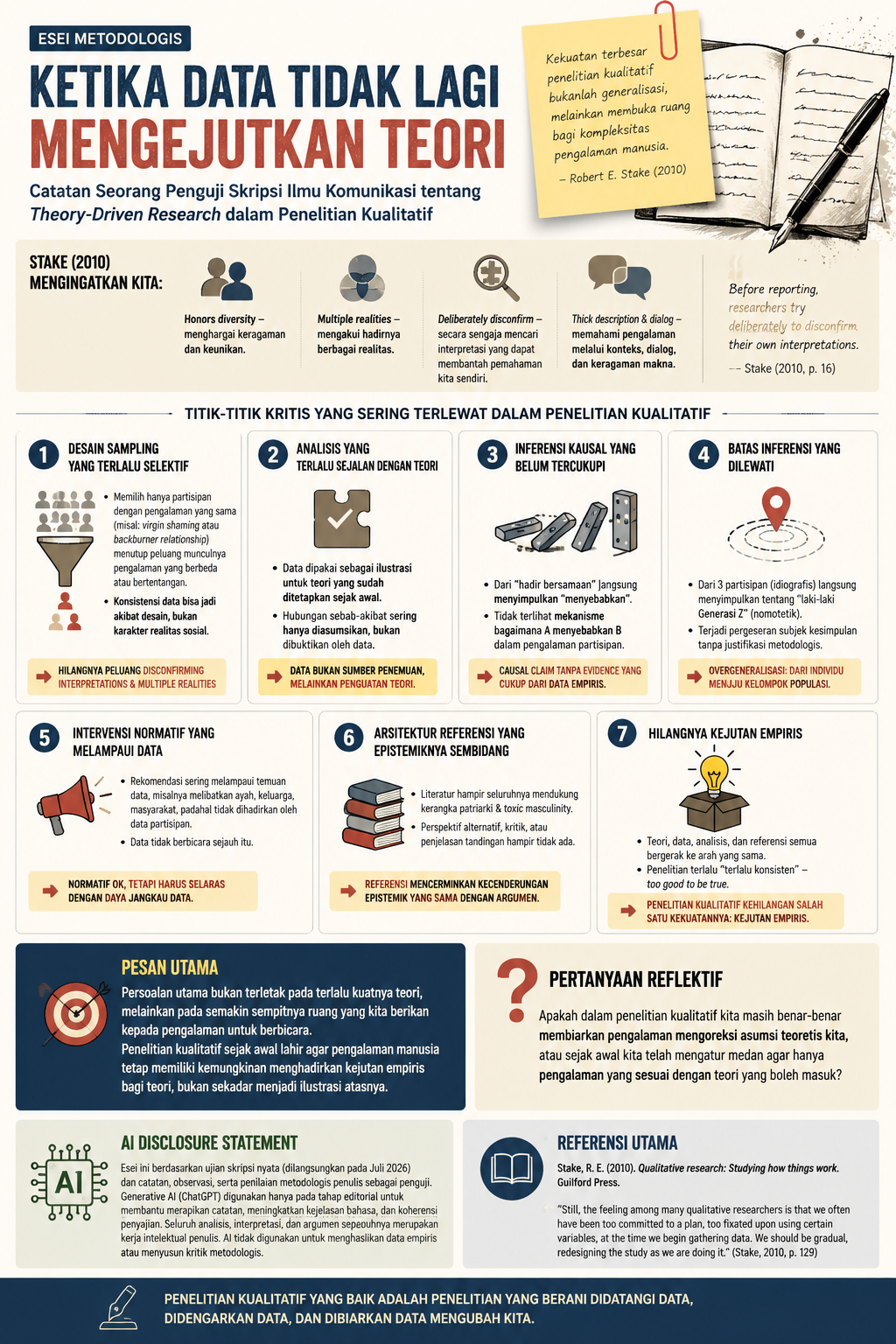
Salah satu kekuatan utama penelitian kualitatif bukanlah kemampuannya menghasilkan generalisasi, melainkan kemampuannya membuka ruang bagi kompleksitas pengalaman manusia. Robert E. Stake (2010) berulang kali mengingatkan bahwa penelitian kualitatif yang baik itu menghargai keragaman, honors diversity, lebih menghargai keunikan daripada keseragaman (uniqueness more than commonality), membuka kemungkinan hadirnya multiple realities, dan bahkan secara sengaja mencari interpretasi yang dapat membantah penafsiran penelitinya sendiri (deliberately disconfirm their own interpretations). Penelitian kualitatif bukanlah proses mengumpulkan bukti untuk mengukuhkan teori yang sudah diyakini, melainkan proses membiarkan realitas berbicara, termasuk ketika realitas tersebut tidak sejalan dengan dugaan awal peneliti.
Robert E. Stake (2010) places openness to multiple realities at the heart of qualitative inquiry. Rather than treating empirical data as confirmation of prior theoretical expectations, he argues that qualitative researchers should deliberately seek interpretations capable of disconfirming their own provisional understandings (pp. 15–16).
Prinsip tersebut melahirkan satu pertanyaan metodologis yang menurut saya penting diajukan kepada banyak penelitian kualitatif kontemporer: Apakah desain sampling yang digunakan benar-benar memberi kesempatan munculnya multiple realities dan disconfirming interpretations, atau justru sejak awal hanya membuka ruang bagi satu jenis pengalaman tertentu?
Pertanyaan ini menjadi relevan ketika peneliti menetapkan kriteria partisipan yang sangat spesifik, misalnya seluruh partisipan harus pernah mengalami virgin shaming atau backburner relationship atau menyandang stigma sosial tertentu, misalnya ADHD. Secara praktis, desain seperti ini memang memudahkan eksplorasi fenomena. Akan tetapi, secara metodologis muncul persoalan yang lebih mendasar.
Stake justru mendorong peneliti untuk secara sengaja mencari interpretasi yang dapat menggugurkan pemahamannya sendiri. Dalam bukunya Qualitative Research: Studying How Things Work (The Guilford Press, 2010), Stake menulis, “Before reporting, researchers try deliberately to disconfirm their own interpretations” (Stake, 2010, p. 16).
Artinya, penelitian kualitatif tidak hanya mengumpulkan pengalaman yang mendukung hipotesis implisit peneliti, tetapi juga aktif mencari pengalaman yang mungkin menunjukkan bahwa interpretasi awal tersebut tidak sepenuhnya benar.
Jika seluruh informan dipilih karena memiliki pengalaman yang sama, peluang munculnya pengalaman yang bertentangan menjadi jauh lebih kecil. Peneliti memang memperoleh data yang konsisten, tetapi konsistensi tersebut bisa jadi merupakan konsekuensi dari desain sampling, bukan semata-mata (menggambarkan) karakter realitas sosial yang diteliti.
Stake juga berulang kali menekankan pentingnya multiple realities. Penelitian kualitatif, menurutnya, justru berusaha melawan stereotipe melalui perhatian terhadap konteks, pengalaman individual, dialog, dan keragaman makna. Thick description, interpretasi alternatif, serta keberadaan berbagai realitas merupakan bagian inheren dari penelitian kualitatif. Kompleksitas tersebut hanya dapat muncul apabila peneliti tetap membuka diri terhadap kemungkinan bahwa pengalaman para partisipan tidak seluruhnya bergerak ke arah yang sama.
Dalam konteks inilah saya mempertanyakan apakah desain penelitian yang sejak awal hanya mengakomodasi satu tipe pengalaman masih sepenuhnya sejalan dengan semangat studi kasus versi Stake.
Stake bahkan mengingatkan bahwa peneliti tidak boleh terlalu terpaku pada rencana penelitian maupun variabel-variabel yang telah ditetapkan sebelumnya. Peneliti kualitatif, menurutnya, tidak jarang menjadi “too committed to a plan” dan “too fixated upon using certain variables.” Lengkapnya, Stake menulis: “Still, the feeling among many qualitative researchers is that we often have been too committed to a plan, too fixated upon using certain variables, at the time we begin gathering data. We should be gradual, redesigning the study as we are doing it” (Stake, 2010, p. 129).
Studi kasus, menurutnya, berusaha tetap naturalistik; peneliti tidak mengintervensi ataupun mengatur realitas agar menghasilkan data yang sesuai dengan desain penelitian.
Di sinilah muncul pertanyaan yang lebih mendasar.
Apabila peneliti sejak awal hanya menerima partisipan yang pernah mengalami virgin shaming, atau backburner relationship, apakah peneliti masih memberi kesempatan kepada realitas untuk muncul secara alamiah? Ataukah sejak awal peneliti telah arranging the field, sehingga hanya satu tipe pengalaman yang boleh masuk ke dalam penelitian?
Dengan kata lain, apakah keterbukaan terhadap pengalaman masih benar-benar dipertahankan, atau justru telah diseleksi sejak proses perekrutan partisipan?
Dapatkah data menjadi ilustrasi teori?
Persoalan tersebut kemudian tampak dalam proses analisis. Sepanjang pembahasan, skripsi yang menjadi fokus analisis saya berulang kali menyimpulkan bahwa standar maskulinitas menyebabkan praktik virgin shaming. Namun hubungan tersebut sering kali tampil sebagai hubungan kausal yang telah diasumsikan, bukan sebagai hubungan yang secara eksplisit diperlihatkan oleh data wawancara. Pertanyaan metodologis yang layak diajukan adalah: bagian mana dari data empiris yang benar-benar menunjukkan hubungan sebab-akibat tersebut, bukan sekadar menunjukkan bahwa kedua fenomena ‘hadir secara bersamaan’ (concurrent)?
Lebih menarik lagi, salah satu partisipan justru menghadirkan pengalaman yang berbeda. Ia tampak lebih menerima dirinya, mengaitkan pilihannya dengan nilai-nilai agama, dan relatif tidak terlalu memedulikan penilaian sosial. Dalam perspektif Stake, pengalaman seperti ini seharusnya memperoleh perhatian khusus karena berpotensi menjadi counter-example yang memperkaya ataupun membatasi interpretasi peneliti.
Namun pengalaman tersebut tidak banyak dimanfaatkan untuk merevisi, memperhalus, atau sekurang-kurangnya membatasi klaim analitis yang telah dibangun sebelumnya. Akibatnya, data yang berpotensi menantang interpretasi justru berubah menjadi pengecualian yang kurang memperoleh tempat dalam argumentasi.
Ketika kesimpulan melampaui daya jangkau data
Persoalan berikutnya muncul pada Bab V. Salah satu kesimpulan menyatakan bahwa praktik virgin shaming merupakan bagian dari konstruksi sosial maskulinitas yang terus direproduksi dalam kehidupan sehari-hari. Pernyataan semacam ini sebenarnya sudah bergerak ke tingkat teori sosial.
Masalahnya, penelitian hanya didasarkan pada tiga wawancara. Tidak ada observasi longitudinal, tidak ada etnografi, tidak ada analisis media, maupun data institusional yang memungkinkan peneliti menyimpulkan bagaimana suatu norma terus direproduksi dalam kehidupan sosial secara luas.
Demikian pula ketika kesimpulan menyebut bahwa fenomena tersebut memengaruhi identitas diri, hubungan sosial, dan cara “laki-laki Generasi Z” memahami maskulinitas. Pertanyaan yang muncul relatif sederhana: mengapa subjek kesimpulan berubah menjadi “laki-laki Generasi Z” secara umum, bukan “ketiga partisipan penelitian ini”?
Perubahan kecil dalam pilihan kata tersebut sebenarnya menunjukkan lompatan langkah penyimpulan (inference) yang cukup drastis.
Objek penelitian juga perlahan bergeser. Penelitian sejak awal menyatakan hendak mengkaji virgin shaming, tetapi pada bagian akhir justru lebih banyak membahas konstruksi maskulinitas secara umum. Pergeseran fokus ini membuat pembaca bertanya apakah penelitian sebenarnya sedang meneliti praktik virgin shaming, atau sedang menggunakan virgin shaming sebagai pintu masuk untuk membahas teori maskulinitas.
Dari deskripsi menuju intervensi normatif
Perubahan posisi epistemologis paling jelas terlihat pada bagian saran. Dengan basis data tiga orang partisipan, penelitian memberikan rekomendasi kepada laki-laki Generasi Z, keluarga, ayah, bahkan masyarakat secara luas. Misalnya, ayah disarankan menerapkan pola pengasuhan yang lebih terbuka dan tidak lagi menuntut anak laki-laki selalu tampil kuat dan dominan.
Pertanyaan kritisnya yang saya ajukan di sini adalah: kapan penelitian ini meneliti ayah? Kapan penelitian ini meneliti keluarga? Kapan penelitian ini meneliti masyarakat?
Rekomendasi tersebut tentu dapat saja masuk akal secara normatif. Namun secara metodologis, rekomendasi tersebut tidak sepenuhnya lahir dari data yang dikumpulkan.
Ironinya cukup menarik. Sejak Bab I penelitian menggunakan paradigma konstruksionis yang menegaskan bahwa realitas merupakan konstruksi sosial. Akan tetapi ketika sampai pada Bab V, posisi peneliti berubah menjadi jauh lebih normatif, seolah ia (si peneliti) telah mengetahui bagaimana masyarakat seharusnya hidup.
Terjadi pergeseran dari descriptive inquiry menuju normative intervention, sementara basis empiris penelitian tidak mengalami perubahan.
Koheren, tetapi penelitian terlihat terlalu Theory-Driven
Di sinilah saya melihat kekuatan sekaligus keterbatasan laporan skripsi ini. Secara internal, penelitian memiliki koherensi yang cukup baik. Paradigma, teori, metode, analisis, hingga kesimpulan saling mendukung satu sama lain. Tidak ada kontradiksi besar di dalam bangunan argumentasinya.
Namun justru karena seluruh komponennya bergerak dalam arah yang sama, muncul kesan bahwa penelitian sejak awal lebih berfungsi mengonfirmasi teori daripada menguji atau memperkaya teori tersebut.
Data empiris akhirnya lebih sering menjadi ilustrasi atas konsep-konsep seperti patriarki, hegemonic masculinity, dan toxic masculinity, daripada menjadi ruang diskusi akademis yang di dalamnya teori-teori tersebut dapat dipertanyakan, dibatasi, atau bahkan dikoreksi.
Akibatnya muncul beberapa konsekuensi metodologis sekaligus: inferensi yang melampaui daya jangkau data, pergeseran objek penelitian, rekomendasi normatif yang kurang ditopang bukti empiris, serta dominasi satu kerangka konseptual tanpa memberi ruang yang cukup bagi penjelasan alternatif.
Daftar pustaka lumayan rapi, tetapi arsitektur epistemiknya rapuh
Kecenderungan tersebut ternyata juga tampak pada daftar pustaka. Secara teknis, format sitasi relatif rapi meskipun masih ditemukan sejumlah ketidaksesuaian. Beberapa referensi memperlihatkan pasangan metadata dan URL yang tidak konsisten, misalnya identitas buku yang justru mengarah ke laman media daring, atau artikel jurnal yang tautannya mengarah ke sumber lain sama sekali.
Selain itu, peneliti masih menggunakan sumber seperti Reddit, Quora, Medium, dan blog pribadi. Penggunaannya tentu tidak otomatis salah apabila diperlakukan sebagai data penelitian, tetapi memerlukan justifikasi yang jauh lebih kuat apabila dijadikan landasan argumentasi akademik.
Yang lebih menarik justru pola keseluruhannya. Literatur yang digunakan hampir seluruhnya bergerak dalam arah yang sama: mengafirmasi patriarki, toxic masculinity, dan kerangka konseptual yang telah dipilih sejak awal. Literatur yang menawarkan kritik, batas konseptual, atau penjelasan alternatif hampir tidak tampak.
Dengan demikian, daftar pustaka sebenarnya mencerminkan kecenderungan epistemik yang sama seperti keseluruhan penelitian: secara teknis cukup tertata, tetapi secara intelektual kurang membuka ruang bagi dialog dengan perspektif yang berbeda.
Di ujung refleksi metodologis ini, persoalan penelitian skripsi yang saya periksa bukan terletak pada konsistensinya. Penelitian ini justru terlalu konsisten, dalam pengertian too good to be true. Teori, data, analisis, hingga referensi bergerak ke arah yang sama sehingga hampir tidak menyisakan ruang bagi kejutan empiris. Padahal salah satu kekuatan terbesar penelitian kualitatif justru terletak pada adanya ruang metodologis bagi keragaman pengalaman manusia untuk mengoreksi asumsi-asumsi teoretis yang telah dibawa peneliti sejak awal.
Fenomena yang saya angkat di sini tentu tidak hanya ditemukan pada satu dua skripsi yang pernah saya periksa sebagai penguji. Dalam beberapa tahun terakhir, sekurang-kurangnya sejak saya dipercaya menjadi pembimbing dan penguji skripsi Ilmu Komunikasi UMN pada September 2024, cukup sering saya menjumpai penelitian kualitatif yang secara teknis semakin rapi, tetapi secara epistemologis semakin tertutup terhadap kejutan empiris. Data tidak lagi diperlakukan sebagai sumber penemuan, melainkan sebagai ilustrasi bagi teori yang telah dipilih sejak awal. Ketika hal itu terjadi, penelitian kualitatif perlahan kehilangan salah satu kekuatan terbesarnya, yaitu kemampuan membiarkan pengalaman manusia yang konkret memodifikasi teori yang abstrak.
Persoalan utama yang kita hadapi sekarang bukan terletak pada terlalu kuatnya teori, melainkan pada semakin sempitnya ruang yang kita berikan kepada pengalaman untuk berbicara. Padahal, bukankah penelitian kualitatif sejak awal lahir agar pengalaman manusia tetap memiliki kemungkinan menghadirkan kejutan empiris bagi teori, bukan sekadar menjadi ilustrasi atasnya?
Infografik pendamping esai metodologis tentang bagaimana penelitian kualitatif dapat menjadi terlalu theory-driven ketika data tidak lagi diberi ruang untuk mengejutkan, mengoreksi, atau memodifikasi teori.
AI Disclosure
This essay grew out of an actual undergraduate thesis examination conducted in July 2026 and reflects the author’s own reading, methodological assessment, and critical judgment in the course of serving as the thesis examiner. Generative AI (ChatGPT) was used only at the editorial stage, primarily to help organize the author’s original notes, improve grammatical clarity, and refine the coherence of the exposition. The case, observations, methodological critique, interpretations, and arguments presented here were developed by the author. AI was not used to generate empirical findings, construct the critique, or make the methodological judgments reported in this essay. The author retains full responsibility for the content and final form of the essay.
Daftar pustaka utama untuk metode skripsi yang saya periksa ini
Stake, R. E. (2010). Qualitative research: Studying how things work. Guilford Press.
Supervisi magang bukan hal yang mudah dilakukan ketika prosesnya mulur-mungkret dalam jejaring manusia-artefak-prosedur. Beberapa hari yang lalu saya menerima rentetan surel yang lumayan “mengagetkan” dari seorang mahasiswa bimbingan magang, sebut saja AJ, yang sudah nyaris selesai dengan tahap pemberkasan laporan magangnya, tapi ada “something in the way.” Isi surelnya bukan tentang teori komunikasi, bukan pula tentang metodologi penelitian. Ia hanya sedang panik.
“Selamat sore Bapak Hendar dan Ibu penguji, semoga Bapak dan Ibu selalu dalam keadaan sehat. Saya izin memberikan informasi, dimana saya telah mengupload Post Exam Report ke dalam portal Pro-Step. Namun setelah mengupload ternyata ada sedikit kesalahan di bagian Halaman Awal – Lembar Pengesahan, dimana saya merename file yang belum tertandatangan. Mohon maaf sebelumnya atas kelalaian saya, Bapak dan Ibu. Saya akan mengupload ulang file tersebut yang benar saat saya sudah memiliki akses tersebut untuk mengupload ulang file saya. Mohon maaf atas ketidaknyamanannya, Bapak dan Ibu. Saya berterima kasih atas waktu dan perhatian Bapak Hendar dan Ibu Penguji […]”
Jadi, menurut ingatannya, setelah memperoleh revisi minor dari perpustakaan, ia justru mengunggah kembali versi lama laporan magangnya ke sistem. Ia takut semuanya harus diulang. Ia bahkan sudah mulai membayangkan kemungkinan terburuk apabila batas waktu administrasi terlampaui.
Sebagai dosen pembimbing, dengan reassuring saya merespon berikut “Dear AJ, biasanya proofreading dilakukan sebelum submission. Rupanya sekarang submission menjadi bagian dari proofreading.”
11 menit kemudian, dia kembali mengirimkan surel dengan wording berikut, “Sekali lagi saya memohon maaf atas kelalaian saya, Bapak dan Ibu. Dikarenakan banyak file yang saya save dalam komputer menyebabkan saya tertukar pada saat menamakan file sebelum diupload. Sekali mohon maaf sekali Bapak dan Ibu, hal ini terjadi karena ketidaksengajaan saya.” (bold saya tambahkan, bukan darinya)
Ternyata setelah dikonfirmasi oleh pihak perpustakaan, file yang tersimpan di sistem justru sudah merupakan versi yang benar. Tidak ada kesalahan unggah. Yang keliru hanyalah ingatannya mengenai apa yang telah ia lakukan beberapa waktu sebelumnya.
Peristiwa di atas tampaknya receh dan inconsequential tapi lumayan membuat saya berefleksi sejenak.
Selama enam bulan terakhir, sejak Februari hingga Juli 2026, saya cukup intensif mendampingi mahasiswa magang dan skripsi. Bersamaan dengan itu saya juga mengembangkan beberapa perangkat administrasi supervisi seperti Submission Gate Form (SGF), Checklist Presisi (CP), Checklist Pascasidang Magang (CPM), serta berbagai jejak dokumentasi lain yang bagi sebagian mahasiswa mungkin dianggap “menambah-nambahi beban administratif”.
Selama ini saya selalu menjelaskan bahwa formulir-formulir tersebut dibuat agar proses supervisi lebih rapi. Namun setelah membaca kembali Husserl beberapa hari terakhir, saya merasa alasan itu ternyata belum cukup mendasar.
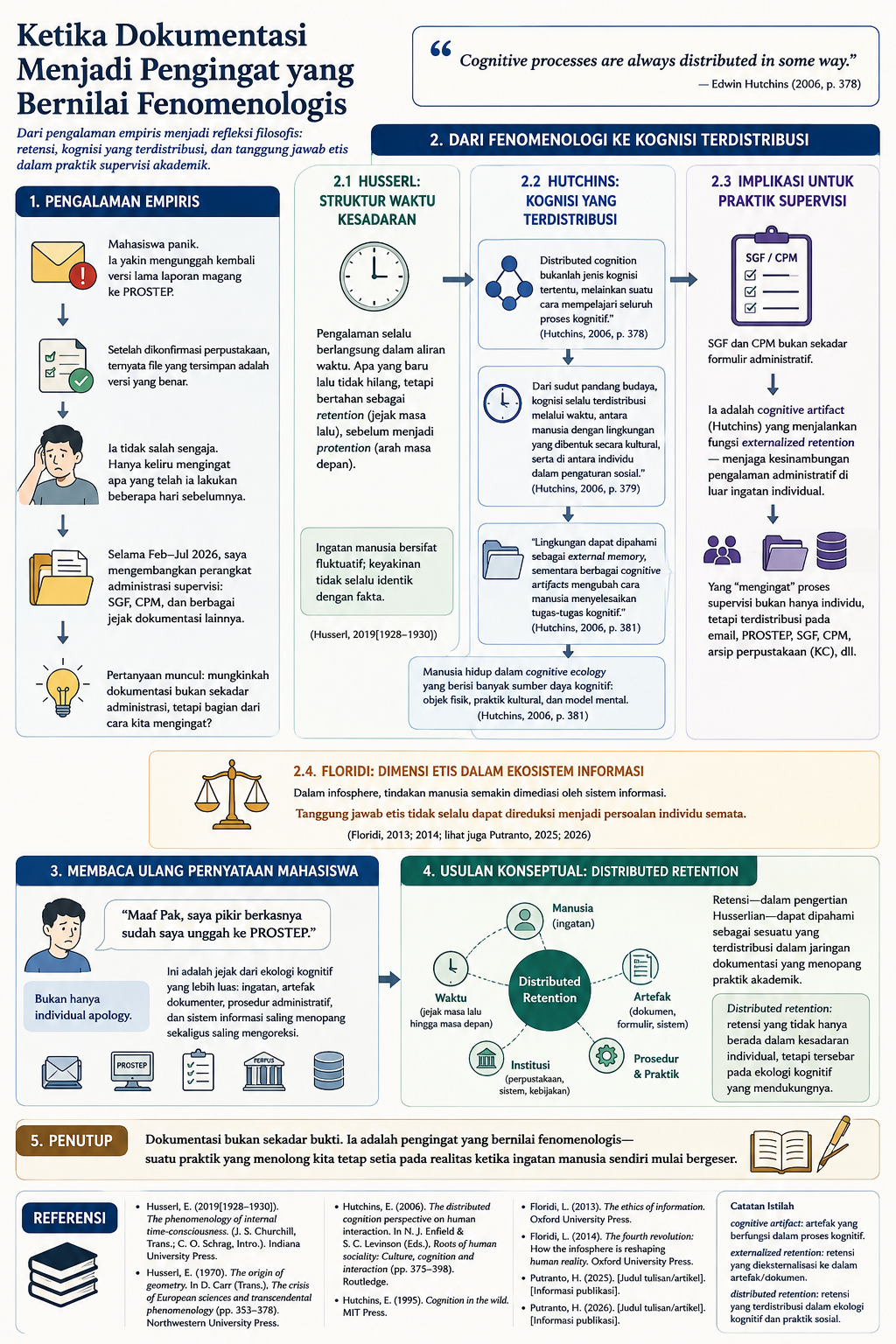
Dalam The Phenomenology of Internal Time-Consciousness, Husserl ([1928-1930] 1964; yang saya baca versi penerbitan Indiana University Press tahun 2019) menunjukkan bahwa pengalaman manusia selalu berlangsung dalam aliran waktu. Apa yang baru saja terjadi tidak pernah hadir kembali secara persis sama dalam kesadaran. Ia bertahan sebagai retention, jejak dari pengalaman yang terus mengalami modifikasi seiring bergeraknya waktu. Kita sering merasa yakin terhadap apa yang kita ingat, padahal keyakinan itu tidak selalu identik dengan apa yang sungguh-sungguh terjadi.
Kasus mahasiswa saya tadi merupakan contoh yang sangat sederhana. Ia tidak berbohong. Ia juga tidak sedang mencari alasan. Ia sungguh percaya bahwa dirinya telah mengunggah dokumen yang salah. Akan tetapi, sistem dokumentasi memperlihatkan sesuatu yang berbeda.
Barangkali formulir-formulir itu bukan sekadar instrumen administrasi. Ia juga bukan sekadar checklist yang harus dipenuhi mahasiswa. Di situlah saya mulai memandang SGF dan CPM secara berbeda. Selama ini saya menganggap keduanya sekadar instrumen administrasi. Namun, setelah membaca karya Husserl ([1964] 2019) pertanyaannya kemudian berubah: mungkinkah sebuah formulir sebenarnya ikut mengambil bagian dalam cara manusia mengingat?
Refleksi pendek di atas kemudian membawa saya kepada gagasan Edwin Hutchins (1995, 2006). Dalam sebuah bab yang memperkenalkan perspektif distributed cognition, Hutchins (2006) menegaskan bahwa distributed cognition bukanlah jenis kognisi tertentu, melainkan suatu cara mempelajari seluruh proses kognitif. Gagasannya bertolak dari premis bahwa cognitive processes are always distributed in some way.
Lebih jauh lagi, Hutchins menjelaskan bahwa dari sudut pandang budaya, kognisi selalu terdistribusi melalui waktu, antara manusia dengan lingkungan yang dibentuk secara kultural, serta di antara individu-individu dalam pengaturan sosial. Hutchins bahkan mengingatkan bahwa lingkungan dapat dipahami sebagai external memory, sementara berbagai cognitive artifacts mengubah cara manusia menyelesaikan tugas-tugas kognitif. Menurut saya, di sinilah SGF memperoleh makna baru. SGF bukan sekadar formulir administrasi. Ia dapat dipahami sebagai cognitive artifact yang menjalankan fungsi externalized retention—yakni mempertahankan kesinambungan pengalaman administratif di luar ingatan individual.
Jelujur pemikiran Hutchins membuat saya berhenti membaca sejenak. Bukankah persoalan mahasiswa saya juga bukan semata-mata persoalan ingatan individual? Yang “mengingat” proses supervisi ternyata bukan hanya dirinya. Email, PROSTEP, SGF, CPM, hingga arsip perpustakaan (KC) secara kolektif mempertahankan jejak pengalaman administratif yang telah berlangsung.
Jika Hutchins membantu saya memahami bagaimana proses kognitif dapat tersebar di antara manusia, artefak, dan lingkungan, gagasan Luciano Floridi tentang bagaimana tanggung jawab moral berubah dalam infosphere (Floridi, 2013, 2014; lihat juga Putranto, 2025, 2026) mengingatkan saya bahwa ketika tindakan manusia semakin dimediasi oleh sistem informasi, tanggung jawab etis pun tidak selalu dapat direduksi menjadi persoalan individu semata. Kedua perspektif tersebut tidak identik, tetapi bersama-sama membuka ruang untuk mempertanyakan kembali bagaimana kita membaca praktik supervisi akademik.
Dengan demikian, ketika seorang mahasiswa berkata, “Maaf Pak, saya pikir berkasnya sudah saya unggah ke PROSTEP,” saya tidak lagi tergesa-gesa membacanya semata-mata sebagai bentuk individual apology atas kelalaian personal. Pernyataan tersebut juga dapat dibaca sebagai jejak dari suatu ekologi kognitif yang lebih luas, tempat ingatan, artefak dokumenter, prosedur administratif, dan sistem informasi saling menopang sekaligus saling mengoreksi. Dalam konteks inilah saya mulai bertanya apakah retensi—dalam pengertian Husserlian—juga dapat dipahami sebagai sesuatu yang terdistribusi melalui jaringan dokumentasi yang menopang praktik supervisi akademik.
Terus terang, saya belum menemukan istilah yang persis untuk menggambarkan kemungkinan tersebut dalam literatur yang saya baca. Untuk sementara, for lack of a better term, saya menyebutnya distributed retention.
Jadi, yang terdistribusi bukan hanya proses berpikir (Hutchins) ataupun tanggung jawab moral (Floridi), melainkan juga retensi mengenai apa yang sungguh telah terjadi. Dalam supervisi akademik, ingatan tentang kapan dokumen dikirim, versi mana yang telah disetujui, siapa yang memberi revisi, dan bagaimana proses itu berlangsung, tidak lagi hanya berada di dalam kepala mahasiswa atau dosen. Ia tersebar di dalam email, sistem PROSTEP, SGF, CPM, arsip perpustakaan, serta berbagai jejak dokumentasi lainnya.
Jika demikian, fungsi dokumentasi sesungguhnya bukan untuk menunjukkan bahwa kita tidak percaya kepada mahasiswa. Justru sebaliknya. Dokumentasi hadir karena kita memahami bahwa manusia memiliki keterbatasan. Sistem yang baik bukanlah sistem yang menggantikan manusia, melainkan sistem yang menolong manusia tetap berpegang pada realitas melalui laporan, catatan, dan jejak dokumentasi ketika ingatan individual mulai bergeser. Sebagaimana diingatkan Borgmann (1999, h. 1), tanpa reports and records, pengalaman manusia dengan cepat akan tenggelam ke dalam ignorance and forgetfulness.
Saya tidak tahu apakah istilah distributed retention akan bertahan sebagai sebuah konsep.
Bisa jadi beberapa bulan lagi saya menemukan istilah yang lebih tepat, atau justru menyadari bahwa gagasan ini sudah pernah dirumuskan oleh orang lain dengan nama berbeda. Namun setidaknya, hari ini saya belajar satu hal: kadang-kadang penemuan konseptual tidak lahir dari ruang seminar atau tumpukan teori, melainkan dari rentetan surel sederhana yang dikirimkan mahasiswa magang bimbingan saya yang awalnya, mungkin, takut gagal dan khawatir disalahkan.
Daftar Pustaka
Borgmann, A. (1999). Holding on to reality: The nature of information at the turn of the millennium. University of Chicago Press.
Floridi, L. (2013). The ethics of information. Oxford University Press.
Floridi, L. (2014). The fourth revolution: How the infosphere is reshaping human reality. Oxford University Press.
Husserl, E. ([1928–1930] 2019). The phenomenology of internal time-consciousness. (M. Heidegger, Ed.; J. S. Churchill, Trans.; C. O. Schrag, Intro.). Indiana University Press. (Original work published 1964)
Husserl, E. (1970). The origin of geometry. In The crisis of European sciences and transcendental phenomenology (D. Carr, Trans., pp. 353–378). Northwestern University Press.
Hutchins, E. (1995). Cognition in the wild. MIT Press.
Hutchins, E. (2006). The distributed cognition perspective on human interaction. In N. J. Enfield & S. C. Levinson (Eds.), Roots of human sociality: Culture, cognition and interaction (pp. 375–398). Routledge.
A personal reflection of Dr. Hendar Putranto, M. Hum. based on a very specific instance during his students’ internship report mentorship at the end of June 2026
#a micro-phenomenology of academic supervision
Over the past few days, I found myself reflecting on two students trying to complete their internship draft submission. To protect their confidentiality, I shall call them JoJo and JeJe, respectively. Whether JoJo and JeJe correspond exactly to any one individual is beside the point. They function here as phenomenological portraits through which certain patterns of students’ academic life become easier to see.
As June gave way to July, both students were entering a demanding stage of their undergraduate studies. Graduation was still some distance away, yet their internship and thesis milestones were becoming increasingly significant. Both communicated frequently with their advisor and wrote politely enough. Yet, in a pathic sense, something felt fundamentally different.
JoJo opened each exchange by acknowledging the support she had already received. Before raising new questions, she took a moment to thank her advisor for the administrative guidance that had helped her reach that point. She then asked what she should prepare for her upcoming internship defense. Her questions did not transfer responsibility to the advisor; rather, they sought guidance so that she could better prepare herself.
JeJe’s communication followed a different trajectory. Messages tended to arrive only when deadlines had become urgent, occasionally well outside what most people would regard as reasonable hours for professional correspondence. One message arrived so early that the roosters had not yet reached a consensus about whether morning had actually begun. 🐓🙂
Apologies were sincere and promptly offered. Yet the same pattern reappeared. The issue, if there was one more serious than unfamiliarity with communication etiquette, was not the absence of knowledge but the repeated failure to bring that knowledge into practice. Metaphorically speaking, her knowledge of communication ethics was not unemployed. It was chronically underemployed. 🙂
At first glance, one might conclude that this is simply a difference in personality or manners. I do not think that explanation goes far enough. Nor, for that matter, is it shallow enough to surf. 🏄🏻♂️
The deeper distinction lies in what each student attends to before acting.
JoJo’s attention appears distributed across the relationship itself. She recognizes the advisor’s prior effort, respects temporal boundaries, and positions her questions within her own responsibility as a learner. Her communication does not eliminate uncertainty; rather, it demonstrates an awareness that academic interaction is a shared practice requiring mutual respect.
JeJe’s attention, by contrast, seems increasingly absorbed by the urgency of the immediate situation. As deadlines become more pressing, the horizon of attention narrows. The advisor gradually appears less as another professional whose time also deserves protection and more as someone expected to resolve an increasingly urgent problem. Apologies follow each incident, yet apologies alone cannot substitute for transformed practice.
It was at this point that I began to suspect the issue had very little to do with communication itself. Communication merely exposed a more fundamental ethical phenomenon: the organization of attention.
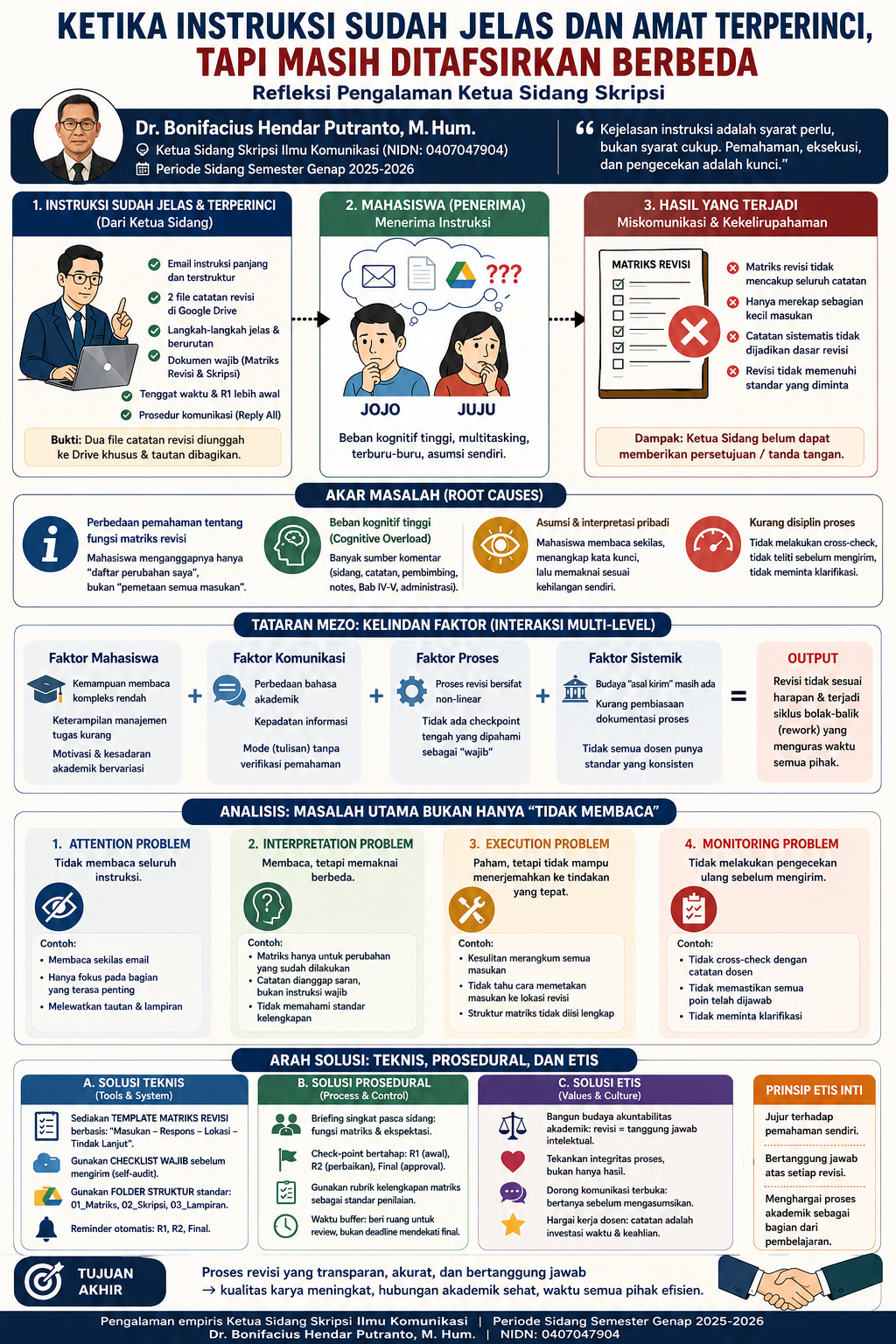
based on the experience of Dr. Hendar as Thesis Exam Chair_Ilkom UMN_periodesidang_Genap 2025-2026
Teaching communication ethics has slowly convinced me that rules are only the visible surface. Students quickly learn appropriate greetings, acceptable hours, and polite expressions. Yet knowing these conventions does not necessarily change what they notice before they write.
Yet ethical communication begins earlier than rule-following. It begins with how attention is organized. Before any message is written, attention has already begun to shape one’s moral vision, allowing some realities to call upon us while others quietly fade from view. Invisibility, after all, rarely arrives with any dramatic flourish.
When disciplined attention weakens, ethical failure rarely begins with dramatic misconduct. It often begins with much smaller phenomena: disregarded boundaries, compressed timelines, shifting responsibility, and the unnoticed fiction that another person’s hours are somehow lighter than our own.
Looking back, I no longer think the problem was communication. Communication simply became the venue where an older habit finally made itself visible. By the time the message arrived, attention had already decided what—and who—mattered enough to notice.
Perhaps that is why communication ethics cannot begin with words. It begins much earlier, with the quiet discipline of learning how to attend to another person’s world before our own urgency occupies the entire horizon.🌒
Written, composed and edited by Dr. Hendar Putranto, M. Hum.
Dosen Pembimbing Skripsi
Prodi Ilmu Komunikasi UMN
Semester Genap 2025-2026
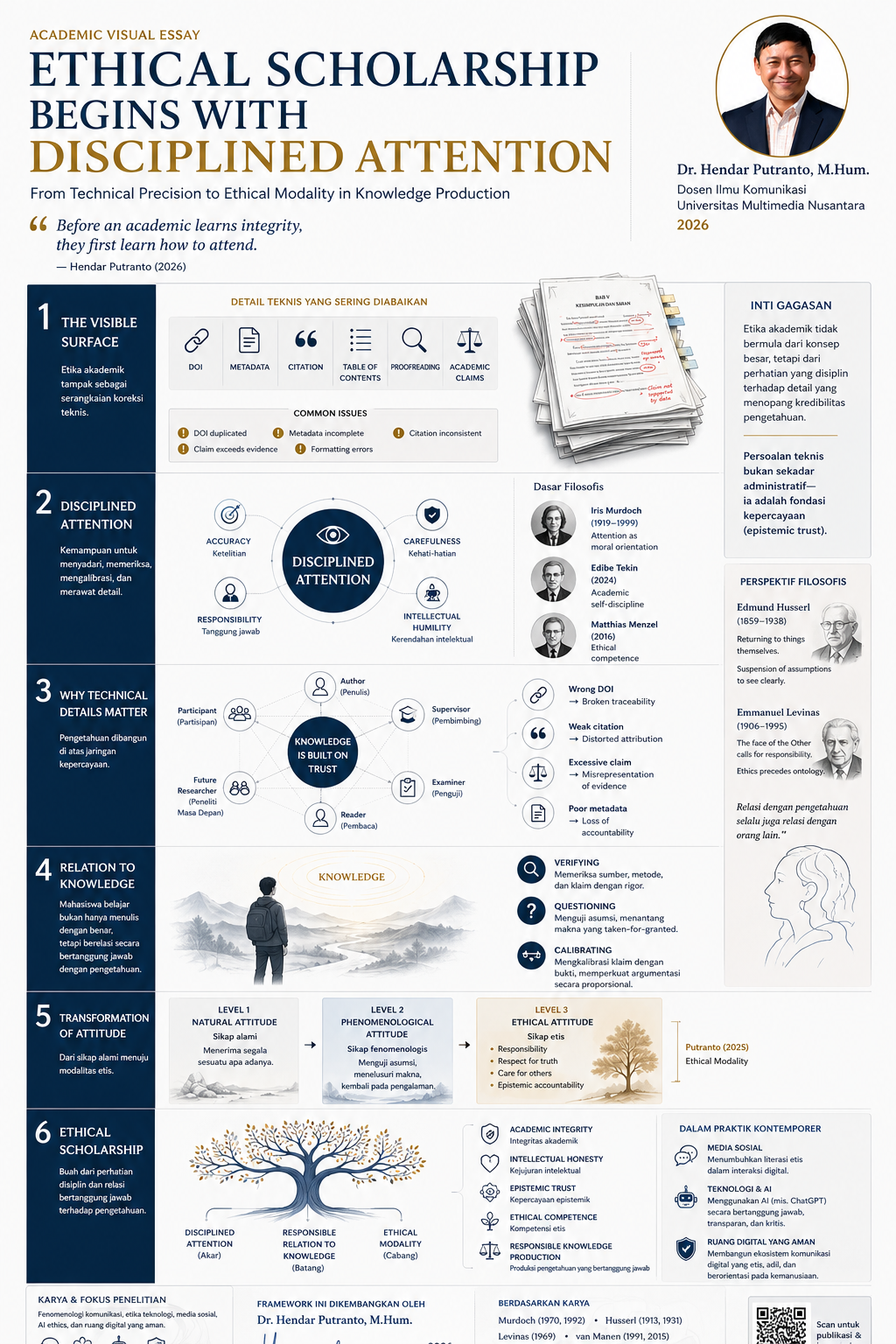
Dalam percakapan tentang etika akademik, tidak jarang kita memulainya dari konsep-konsep besar seperti integritas, kejujuran, tanggung jawab, akuntabilitas, atau bahkan keadilan epistemik. Namun pengalaman saya membimbing beberapa mahasiswa tingkat akhir belakangan ini justru menyiratkan kesan dan membuka proposisi baru bahwasanya etika produksi pengetahuan sering kali tidak dimulai dari konsep-konsep besar tersebut. Ia bermula dari sesuatu yang jauh lebih sederhana yaitu perhatian yang disiplin (disciplined attention).
Tiga minggu pertama di bulan Juni, circa 15-20 Juni 2026, saya mulai memeriksa draf skripsi tujuh orang mahasiswa yang tengah mempersiapkan diri menuju sidang. Secara substantif, sebagian besar penelitian mereka telah memenuhi syarat. Pertanyaan penelitian telah dijawab, temuan telah dirumuskan, dan argumentasi utama telah dibangun. Namun ketika naskah diperiksa lebih dekat, masih ditemukan berbagai persoalan yang tampaknya bersifat teknis: DOI yang ditulis ganda, metadata referensi yang tidak lengkap, nama akademisi yang tidak diperbarui sesuai jabatan terkini, daftar isi yang tidak rapi, hingga kesimpulan yang mengklaim lebih banyak (overclaim) daripada yang sesungguhnya dapat didukung oleh data.
Pada titik inilah saya kembali mempertanyakan asumsi umum bahwa persoalan teknis dan persoalan etis merupakan dua wilayah yang terpisah. Dalam praktik produksi pengetahuan, keduanya justru berkelindan erat. Apa arti sebuah DOI yang salah? Apa pentingnya nama penulis yang tidak ditulis secara konsisten? Mengapa metadata referensi harus diperiksa berulang kali? Bukankah semua itu hanya persoalan administratif?
Pertanyaan-pertanyaan tersebut sepertinya masuk akal sampai kita menyadari bahwa pengetahuan akademik dibangun di atas jaringan kepercayaan. Ketika seorang penulis mencantumkan sebuah sumber, pembaca mempercayai bahwa sumber tersebut benar-benar ada, dapat dilacak, dan direpresentasikan secara akurat. Ketika seorang peneliti menyimpulkan sesuatu dari data, pembaca mempercayai bahwa kesimpulan tersebut tidak melampaui apa yang dapat ditunjukkan oleh data itu sendiri. Artinya, setiap tindakan teknis dalam penulisan akademik sesungguhnya mengandung dimensi etis.
Pengalaman memeriksa tujuh draf skripsi dalam beberapa hari terakhir mengingatkan saya pada sebuah ironi kecil dalam praktik pembimbingan skripsi (thesis supervision). Sebagian besar mahasiswa datang dengan ekspektasi bahwa mereka akan berhadapan dengan seorang dosen pembimbing yang killer. Mereka mengira tugas utama pembimbing adalah memeriksa kesesuaian topik, metode penelitian, dan hasil analisis. Namun dalam kenyataannya, ketika naskah mendekati tahap akhir, acap kali saya mendapati diri memainkan peran yang jauh lebih beragam.
Pada satu halaman saya bertindak sebagai copy editor yang memeriksa konsistensi kapitalisasi judul dan metadata referensi. Pada halaman berikutnya saya berubah menjadi managing editor yang menelusuri DOI yang ditulis ganda atau sumber yang tidak lengkap. Beberapa saat kemudian saya mengambil posisi sebagai reviewer metodologi yang mempertanyakan justifikasi penggunaan metode netnografi atau semiotika Barthes, atau fenomenologi IPA, perbedaan antara teknik pengumpulan data dan teknik analisis data, juga hubungan antara observasi dan wawancara. Tidak jarang saya bahkan harus berperan sebagai penguji bayangan yang mencoba mengantisipasi pertanyaan-pertanyaan yang mungkin muncul dalam sidang.
Dari sudut pandang mahasiswa, situasi ini mungkin terasa berlebihan. Pada dasarnya mereka berharap memperoleh satu peran saja dari DosPem, tetapi, pada kenyataannya, justru berhadapan dengan empat atau lima peran sekaligus. Dari yang awalnya membayangkan berhadapan dengan dosen killer, mungkin pada akhir sesi bimbingan mereka sudah melabeli saya sebagai dosen yang teliti dan cerewet. 🙂
Terlepas dari kekhawatiran jamak soal pelabelan tersebut, semakin saya merefleksikannya, semakin saya menyadari bahwa keragaman posisi tersebut bukanlah bentuk perfeksionisme administratif. Setidaknya bukan itu tujuan utamanya. Posisi-posisi tersebut diperlukan karena produksi pengetahuan akademik memang tidak pernah hanya soal menghasilkan temuan. Produksi pengetahuan juga mencakup kemampuan memverifikasi sumber, mempertanggungjawabkan metode, menjaga presisi bahasa, mengkalibrasi kekuatan klaim, dan menghormati kontribusi intelektual orang lain melalui sitasi yang akurat dan taat azas (APA 7).
Dalam pengertian ini, pembimbingan skripsi bukan hanya proses memperbaiki dokumen melainkan ruang pembentukan habitus. Melalui koreksi yang tampak teknis, mahasiswa sesungguhnya sedang berlatih mengembangkan modalitas etis tertentu, misalnya, ketelitian, kehati-hatian, tanggung jawab, dan kesediaan untuk memberi perhatian pada detil yang menopang bangunan kredibilitas pengetahuan.
Karena itu, ketika saya meminta seorang mahasiswa memperbaiki DOI yang salah, melengkapi metadata referensi, atau menuliskan kesimpulan dengan lebih hati-hati, yang sedang dipertaruhkan sesungguhnya bukan sekadar format. Yang sedang dilatih adalah cara berelasi dengan pengetahuan. Dengan kata lain, persoalan utama yang sedang dipelajari mahasiswa sesungguhnya bukan hanya bagaimana menulis skripsi yang benar, melainkan bagaimana membangun relasi yang bertanggung jawab dengan pengetahuan yang sedang diproduksinya. Artinya, kompetensi etis acap kali dibangun pertama-tama melalui kompetensi teknis, tetapi, setelah bergulir, secara simultan akan memperdalam dan menguatkan kompetensi teknis tersebut.
Dalam praktik produksi pengetahuan, fakta dan nilai tidak selalu hadir sebagai dua wilayah yang sepenuhnya terpisah. Seorang peneliti memang dituntut untuk menghormati fakta sebagaimana adanya, tetapi fakta hanya dapat dikenali melalui perhatian, pertimbangan, dan penilaian yang terus-menerus. Ketika seorang mahasiswa memeriksa kembali referensinya, mengkalibrasi kekuatan klaimnya, atau menahan diri dari interpretasi yang berlebihan, ia tidak sekadar mematuhi prosedur akademik melainkan sedang belajar mengembangkan disposisi tertentu terhadap kebenaran (Murdoch, 1992). Dengan demikian, ketelitian akademik dapat dipahami sebagai salah satu turunan konkret dari modalitas etis yang menopang produksi pengetahuan yang bertanggung jawab (Putranto, 2025).
Temuan empiris mutakhir juga menunjukkan bahwa perhatian bukan sekadar kualitas psikologis individual, melainkan bagian dari disiplin akademik yang dapat dipelajari dan dikembangkan. Dalam studi terhadap mahasiswa universitas, academic self-discipline ditemukan berkaitan erat dengan kemampuan mempertahankan perhatian, mengelola distraksi, bekerja secara terencana, dan mencapai tujuan akademik (Tekin, 2024). Sejalan dengan itu, kompetensi etis tidak cukup dipahami sebagai pengetahuan tentang aturan atau kode etik semata, melainkan mencakup kemampuan untuk mengumpulkan informasi yang relevan, melakukan pertimbangan yang cermat, dan mengambil keputusan yang bertanggung jawab dalam praktik sehari-hari (Menzel, 2016).
Dengan demikian, perhatian yang disiplin dapat dipahami baik sebagai keutamaan pribadi (virtues) maupun sebuah prasyarat pengembangan kompetensi etis dalam produksi pengetahuan. Jika perhatian yang disiplin menjelaskan praktik yang sedang dilatih, modalitas etis membantu menjelaskan transformasi sikap yang memungkinkan praktik tersebut berkembang.
Dalam penelitian doktoral saya mengenai etika komunikasi produksi pengetahuan, saya menemukan bahwa pembentukan modalitas etis tidak berlangsung secara acak dan instan. Ia bergerak melalui pergeseran bertahap dari sikap alamiah, menuju sikap fenomenologis, dan akhirnya menuju sikap etis (Putranto, 2025). Dalam terang pengalaman supervisi skripsi yang saya ceritakan di atas, perhatian yang disiplin tampaknya memainkan peran penting dalam proses tersebut. Ketika mahasiswa mulai memeriksa kembali sumber yang digunakan, mempertanyakan kekuatan klaim yang dibuat, atau menahan diri dari generalisasi yang berlebihan, mereka perlahan bergerak keluar dari kecenderungan menerima sesuatu begitu saja menuju cara berelasi yang lebih reflektif dan bertanggung jawab dengan pengetahuan yang sedang diproduksinya (Putranto & Siahaan, 2026).
Semakin saya mencecap-cecap pengalaman supervisi mahasiswa di tahap akhir menjelang submisi draf skripsi, semakin tebal kesadaran saya bahwa perhatian yang dimaksud di sini bukan sekadar kemampuan teknis untuk menemukan kesalahan. Perhatian merupakan cara tertentu dalam memandang dan menghadirkan sesuatu sebagaimana adanya (Murdoch, 1970, 1992). Ketika seorang mahasiswa memeriksa kembali sebuah sitasi, membedakan antara temuan dan interpretasi, atau menahan diri dari klaim yang tidak didukung data, ia sesungguhnya sedang belajar melihat dengan lebih jernih.
Dalam pengertian ini, perhatian bukan hanya keterampilan akademik, melainkan juga bentuk orientasi moral. Melalui perhatian yang cermat, seseorang berusaha mengurangi distorsi yang berasal dari kelalaian, prasangka, atau keinginan untuk terlihat lebih meyakinkan daripada yang sebenarnya dapat dibuktikan, atau, menyitir Murdoch (1970), tertarik pada dan ditarik oleh kebenaran.
Selain itu, perhatian akademik tidak pernah hanya diarahkan kepada teks atau data semata. Ia juga merupakan bentuk tanggung jawab terhadap orang lain yang akan membaca, menggunakan, dan mempercayai pengetahuan yang kita hasilkan. Ketika seorang mahasiswa diminta memperbaiki metadata referensi atau mengkalibrasi kekuatan kesimpulannya, yang sedang dipelajari bukan hanya ketepatan teknis, melainkan juga sikap menghormati pihak lain yang hadir dalam relasi pengetahuan tersebut: penulis yang disitasi, partisipan penelitian yang telah berbagi pengalaman, penguji yang akan menilai, serta pembaca yang kelak bergantung pada akurasi informasi yang disajikan. Karena itu, perhatian yang disiplin sekaligus merupakan bentuk kepedulian pedagogis yang mengajarkan bagaimana seseorang bertanggung jawab terhadap liyan dan terhadap dunia yang lebih luas daripada dirinya sendiri (Levinas, 1969; van Manen, 2015).
Tidak mengherankan bahwasanya perhatian yang disiplin dapat dipahami sebagai modalitas etis awal yang membentuk cara seseorang melihat, menilai, dan bertindak secara bertanggung jawab dalam produksi pengetahuan (bdk. Murdoch, 1970; Levinas, 1969; van Manen, 1991; Putranto, 2025). Di sinilah perhatian yang disiplin menjadi penting. Sebelum seorang akademisi berbicara tentang integritas, ia terlebih dahulu belajar memperhatikan. Perhatian yang disiplin bukan sekadar keterampilan teknis, melainkan disposisi etis yang memungkinkan pengetahuan diproduksi secara bertanggung jawab. Dalam konteks ini, saya sampai pada butir pemahaman bahwasanya etika produksi pengetahuan bukan pertama-tama sebagai seperangkat aturan normatif, melainkan sebagai modalitas praktis yang termanifestasi dalam tindakan-tindakan kecil yang berulang sekaligus bermakna (bdk. Putranto & Siahaan, 2026).
Akhirul kata, etika akademik bukan hanya dipandu adanya niat baik dan omongan saleh tentang hal-hal yang normatif, melainkan justru dipelopori oleh sikap memberi perhatian yang terarah dan dengan disiplin kepada hal-ihwal yang sedang dikerjakannya.
Ethical scholarship begins with disciplined attention.
Daftar Pustaka
Erduran Tekin, Ö. (2024). Academic self-discipline as a mediating variable in the relationship between social media addiction and academic achievement: Mixed methodology. Humanities and Social Sciences Communications, 11, Article 1096. https://doi.org/10.1057/s41599-024-03633-x
Levinas, E. (1969). Totality and infinity: An essay on exteriority (A. Lingis, Trans.). Duquesne University Press. (Original work published 1961).
Menzel, D. C. (2016). Ethical competence. In A. Farazmand (Ed.), Global encyclopedia of public administration, public policy, and governance. Springer. https://doi.org/10.1007/978-3-319-31816-5_2458-1
Murdoch, I. (1970). The sovereignty of good. Routledge.
Murdoch, I. (1992). Metaphysics as a guide to morals. Penguin Books.
Putranto, B. H. (2025). Etika komunikasi produksi pengetahuan: Studi fenomenologi praktik atas modalitas etis berdasarkan pengalaman akademisi dalam penulisan ilmiah [Unpublished doctoral dissertation]. Universitas Indonesia.
Putranto, B. H., & Siahaan, R. A. (2026). Reconstructing communication ethics in academic knowledge production: A phenomenology of practice approach. In B. H. Putranto et al. (Eds.), Proceedings of the International Conference on Communication and New Media Studies (COMNEWS 2025) (Advances in Social Science, Education and Humanities Research, Vol. 1015, pp. 183–193). Atlantis Press. https://doi.org/10.2991/978-2-38476-573-7_19
van Manen, M. (2015). Pedagogical tact: Knowing what to do when you don’t know what to do. Routledge.
van Manen, M. (1991). The tact of teaching: The meaning of pedagogical thoughtfulness. State University of New York Press.
Hari ini, Jumat, 26 Juni 2026, saya mengenang kembali setengah tahun pertama tahun 2025, atau, setengah tahun terakhir perjalanan studi saya di Program Doktoral Ilmu Komunikasi, FISIP Universitas Indonesia, yang akhirnya berpuncak pada sidang promosi Doktor dalam Ilmu Komunikasi yang berlangsung pada Kamis, 26 Juni 2025, pukul 14-16 WIB, bertempat di Auditorium Juwono Sudarsono (AJS), FISIP UI, Depok.
Berikut sejumlah foto-foto yang capture that moment; saat berahmat yang akan terus saya syukuri sampai penghujung hayat.
Prof. Dr. Billy Koernianti Sarwono, M.A. sebagai Promotor saya yang telah membimbing saya dengan sabar dan mendewasakan saya dalam berpikir, berargumentasi, dan menulis jadi lebih sederhana dan terpahami.
Co-promotor: Romo Johannes Haryatmoko, Ph. D., SJ yang telah mengasah logika berpikir saya dengan tekun, sabar dan kritis sehingga akhirnya saya sampai pada perumusan conceptual novelty disertasi ini, yaitu modalitas etis, dengan menggunakan pendekatan fenomenologi praktik dari Max van Manen (2014, 2023)
Co-promotor: Dr. Irwansyah, M. A.
Dewan Penguji yang terdiri dari internal,
Whisnu Triwibowo, Ph. D. yang telah memberikan kritik, saran, dan masukan sejak tahap proposal sampai pasca SHP-2.
Dr. Camelia Catharina, M. Si. yang telah menemani proses understand what it takes sebagai mahasiswa program Doktoral Ilmu Komunikasi di UI sejak 2019 sampai selesainya; juga menuntun penajaman bagian metodologi dan simpulan.
dan eksternal,
Prof. Deddy Mulyana M.A., Ph.D. yang telah menajamkan aspek intercultural dan metodologis penelitian disertasi ini. Lae Fitzerald Kennedy Sitorus, Ph. D. yang telah melakukan tugasnya dengan baik, khususnya dalam menyanggah bagian literature review dan temuan.
Terima kasih juga kepada ketua sidang: Prof. Dr. Semiarto Aji Purwanto, Guru Besar Antropologi UI & Dekan FISIP UI (2021-2025)
Mas Eri (Kaprodi Pasca), mbak Dina (Sekprodi Pasca), bu Hendriyani (Ketua Dept. Komunikasi UI), mbak Nina, bang Ade, mbak Ummi, mbak Donna, Almarhum mas Pinckey Triputra (+ 21 Juli 2023), dan semua dosen pengajar saya selama matrikulasi dan perkuliahan. Mbak Ayu, mas Mugi, mas Hendra, mas Yusuf, dan semua staf Pascasarjana Komunikasi UI di Salemba.
Empat orang narasumber di Jakarta, Yogyakarta, Malang, & Denpasar yang telah bersedia membagikan pengalaman hidup mereka (lived experience) menjadi seorang communication scholar yang menghasilkan pengetahuan dalam ilmu komunikasi, media, dan budaya dalam beragam format, khususnya artikel yang terbit di jurnal internasional bereputasi, monograf, white paper & policy brief, dan lain-lainnya.
Mbak Sandra dan mas Aldi sebagai pendamping promovendus.
Panitia kecil yang diketuai Dr. Henilia Yulita, dan dikawal oleh mas Pronky (Arindra Khrisna Karamoy, S.E., M.Si., M.I.Kom.), mas Taufan, bang Rony, mbak Thya, juga rekan-rekan mahasiswa yang sudah membantu di meja penerima tamu (Fidel & Frelly the Sisters) serta menjadi fotografer (Dessy & Kezia).
Rekan-rekan pimpinan dan kolega di UMN: Rektor, Ketua Senat, Para Wakil Rektor, Dekan FIKOM UMN, Dekan FTI, Kaprodi & Sekprodi Ilmu Komunikasi, Jurnalistik, PJJ Ilkom, dan MIKOM. Tentu saja rekan-rekan dari UMN (HRD, Prodi Arsitektur, Perfilman, dan lainnya), khususnya dari rumah saya Prodi Ilmu Komunikasi, fulltime dan homebase, yang luar biasa ramai hampir memenuhi Auditorium & dan Zoom.
Rekan-rekan dari STF Driyarkara + IKAD STF Driyarkara (mbak Yuth, Reza, and many others), KAPAL Perempuan, SESAWI, Manresa’98, dan dari kampus-kampus serta afiliasi-afiliasi lain yang berkenan hadir menyemangati saya.
Rekan-rekan gerbong angkatan 2019: mas Hary, mbak Rani, bro Hanif, mas Mubarok, mas Verdy, mbak Ikrima, mbak Nurly, dan teh Rieke Diah Pitaloka. Juga angkatan 2016, 2017, 2018, 2020 s/d 2023 yang saya kenal dan mengenal saya, di dalam dan di luar ruang kelas, dalam sejumlah perjumpaan akademik dan non-akademik.
Tentu saja ucapan terima kasih yang sedalam-dalamnya saya tujukan kepada keluarga tercinta, istri, putri dan mama tercinta. Hadir juga Tante dan Om dari Cengkareng serta beberapa circle keluarga dan handai taulan. Disertasi ini juga saya persembahkan untuk Almarhum Papa yang sudah lebih dulu beristirahat dengan kekal dalam Kerajaan Surga (11 Agustus 2021), seminggu setelah saya mempertahankan proposal disertasi.
Akhirul kata, semoga rekan-rekan yang masih terus berjuang menyelesaikan studi S3-nya di UI dan di manapun pada akhirnya dapat menemukan closure for the inner struggle yang dialami masing-masing calon Promovendus dengan derajat intensitas kognisi, afeksi, dan volisi yang berbeda-beda. :p
Memoar percakapan dua mahasiswa doktoral pada penghujung Oktober 2021
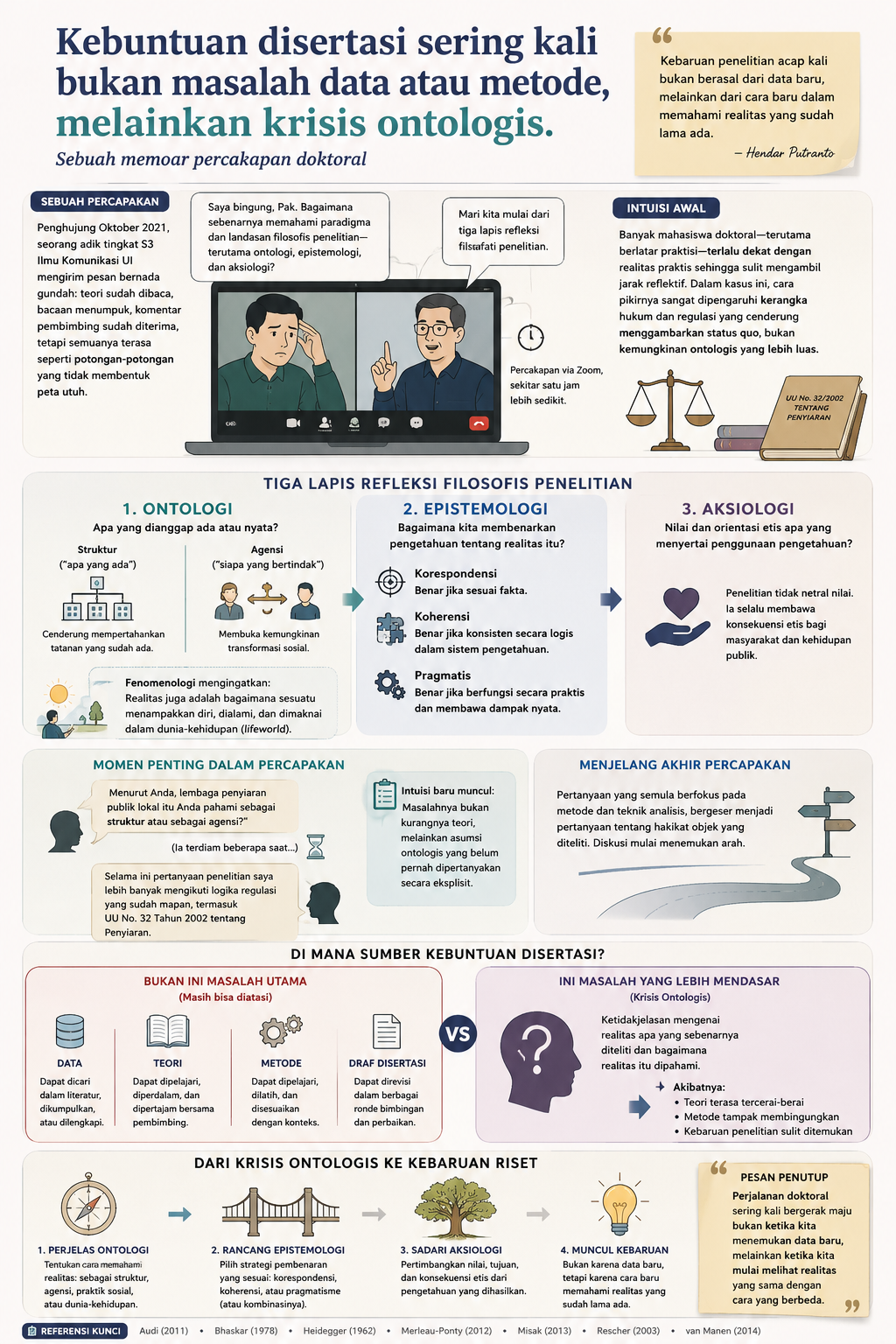
Pada penghujung Oktober 2021 saya menerima pesan singkat bernada gundah dari seorang adik tingkat di Program Doktor Ilmu Komunikasi Universitas Indonesia. Ia sedang berada dalam fase yang sangat umum dialami oleh mahasiswa doktoral: kebingungan konseptual. Bahan bacaan sudah menumpuk, teori sudah dibaca, komentar pembimbing sudah diterima, tetapi semuanya terasa seperti potongan-potongan yang tidak membentuk peta utuh. Pertanyaannya sederhana tetapi fundamental: bagaimana sebenarnya memahami paradigma dan landasan filosofis penelitian—terutama ontologi, epistemologi, dan aksiologi—dalam kerangka penelitian komunikasi?
Percakapan kami berlangsung via Zoom, sekitar satu jam lebih sedikit. Saya memantik diskusi dengan cara yang paling sederhana terlebih dahulu: penelitian ilmiah selalu berdiri di atas tiga lapis refleksi filosofis. Pertama adalah ontologi, yaitu pertanyaan tentang apa yang dianggap ada atau nyata. Kedua adalah epistemologi, yakni bagaimana kita membenarkan pengetahuan tentang realitas tersebut. Ketiga adalah aksiologi, yaitu nilai dan orientasi etis yang menyertai penggunaan pengetahuan tersebut.
Bagi banyak mahasiswa doktoral ilmu sosial, terutama yang memiliki latar belakang praktisi, kesulitan biasanya muncul pada lapisan ontologis. Mereka sering kali terlalu dekat dengan realitas praktis yang sehari-hari mereka hadapi sehingga sulit mengambil jarak reflektif. Dalam percakapan itu saya melihat persoalan serupa. Adik tingkat saya bekerja dalam ekosistem regulasi penyiaran sehingga cara berpikirnya sangat dipengaruhi oleh kerangka hukum dan aturan formal. Di situ letak masalahnya: hukum sering kali hanya menggambarkan status quo, bukan kemungkinan ontologis yang lebih luas.
Untuk menjelaskan hal tersebut saya menggunakan contoh sederhana. Jika seseorang meneliti lembaga penyiaran publik lokal, pertanyaan ontologis pertama sebenarnya sangat mendasar: apakah lembaga itu dipahami sebagai struktur atau sebagai agensi? Jika dilihat sebagai struktur, maka penelitian cenderung menggambarkan bagaimana lembaga tersebut mempertahankan tatanan yang sudah ada. Namun jika dipahami sebagai agensi, maka penelitian dapat mengeksplorasi potensi transformasi sosial yang dibawa oleh lembaga tersebut. Perubahan sudut pandang ontologis seperti ini sering kali sudah cukup untuk membuka kemungkinan kebaruan penelitian.
Ketika saya mengajukan pertanyaan itu—apakah lembaga penyiaran publik lokal dipahami sebagai struktur atau sebagai agensi—ia terdiam beberapa saat. Setelah itu ia mengakui bahwa selama ini pertanyaan penelitiannya lebih banyak mengikuti logika regulasi yang sudah mapan, di antaranya Undang-undang (UU) Nomor 32 Tahun 2002 tentang Penyiaran. Di titik itulah saya melihat bahwa persoalannya bukan terletak pada kurangnya teori, melainkan pada asumsi ontologis yang belum pernah dipertanyakan secara eksplisit.
Namun demikian, ontologi tidak selalu berhenti pada pertanyaan tentang apa yang ada atau bagaimana status suatu entitas dipahami. Dalam tradisi fenomenologi, ontologi juga berkaitan dengan bagaimana sesuatu menampakkan diri, dialami, dan memperoleh makna dalam dunia-kehidupan manusia (Heidegger, 1962; Merleau-Ponty, 2012; van Manen, 2014). Lembaga penyiaran publik, misalnya, tidak hanya dapat dipahami sebagai struktur atau agensi, tetapi juga sebagai dunia-kehidupan (lifeworld) yang dihayati oleh para pekerja media, pendengar, dan komunitas yang berinteraksi dengannya. Pergeseran fokus dari “apa itu lembaga” menuju “bagaimana lembaga itu dialami dan dimaknai” sering kali membuka dimensi penelitian yang sebelumnya tidak terlihat.
Di titik inilah pentingnya memahami tradisi filsafat ilmu yang lebih luas. Dalam sejarah filsafat Barat, perdebatan ontologis klasik sering digambarkan sebagai pertarungan antara realisme dan idealisme. Realisme berangkat dari anggapan bahwa realitas ada secara independen dari pikiran manusia, sementara idealisme melihat ide atau struktur kesadaran sebagai unsur utama realitas (Audi, 2011). Dalam perkembangan lebih mutakhir, Roy Bhaskar mengembangkan apa yang disebut sebagai critical realism, sebuah pendekatan yang berusaha menjembatani realitas objektif dengan proses pengetahuan yang selalu bersifat historis dan fallible (Bhaskar, 1978).
Setelah ontologi, lapisan berikutnya adalah epistemologi. Di sini pembahasan beralih pada teori kebenaran. Tradisi filsafat umumnya mengenal beberapa teori besar, antara lain teori korespondensi, teori koherensi, dan teori pragmatis (Rescher, 2003). Teori korespondensi menyatakan bahwa suatu pernyataan benar jika sesuai dengan fakta. Teori koherensi menilai kebenaran dari konsistensi logis antara proposisi dalam suatu sistem pengetahuan. Sementara itu pragmatisme, yang berkembang dalam pemikiran Charles Sanders Peirce, William James, dan John Dewey, menilai kebenaran dari keberfungsian praktis suatu gagasan (Misak, 2013).
Dalam diskusi tersebut saya mengerangkakan setumpuk gagasan bahwa kebaruan penelitian acap kali muncul ketika peneliti mampu menggabungkan kerangka ontologis yang tepat dengan strategi pembenaran epistemologis yang jelas. Sebagai contoh, jika seorang peneliti mengklaim bahwa lembaga penyiaran lokal berfungsi sebagai agensi sosial, klaim itu harus didukung oleh argumen epistemologis yang kuat: apakah melalui korespondensi empiris, konsistensi teoretis, atau justru melalui pendekatan pragmatis yang menunjukkan dampak nyata lembaga tersebut dalam kehidupan publik.
Menariknya, percakapan itu akhirnya memperlihatkan sesuatu yang sering terjadi dalam pendidikan doktoral. Pengalaman itu juga mengingatkan saya pada banyak percakapan lain dengan mahasiswa doktoral, baik dalam angkatan maupun lintas angkatan, yang saya jumpai sepanjang perjalanan studi doktoral saya. Tidak sedikit mahasiswa doktoral yang sebenarnya memiliki intuisi kritis yang tajam ketika berbicara secara lisan, tetapi lalu mengalami kesulitan menerjemahkannya ke dalam tulisan akademik. Dalam kasus kegundahan yang dialami adik tingkat saya itu, masalahnya bukan pada kurangnya ide, atau kurang menariknya fenomena untuk diteliti pada tataran empiris, melainkan belum tersusunnya kerangka filosofis yang memetakan ide-ide tersebut secara sistematis.
Menjelang percakapan berakhir, saya mulai melihat perubahan caranya berbicara tentang arah pertanyaan penelitiannya. Pertanyaan-pertanyaan yang sebelumnya berputar pada metode dan teknik analisis perlahan bergeser menjadi pertanyaan tentang hakikat objek yang sedang ditelitinya. Pergeseran kecil itu tampak sepele, tetapi justru di sanalah diskusi sesungguhnya mulai berkecambah dan menemukan arahnya.
Pengalaman tersebut menggugah kesadaran saya bahwa krisis yang paling sering dialami mahasiswa doktoral sesungguhnya bukan krisis data, teori, ataupun metode. Ketiga hal itu biasanya masih dapat dicari dalam literatur, dipelajari melalui perkuliahan, dipertajam bersama pembimbing, atau diperbaiki melalui berbagai revisi naskah disertasi. Yang lebih mendasar adalah krisis ontologis: ketidakjelasan mengenai realitas apa yang sebenarnya sedang diteliti dan bagaimana realitas itu dipahami. Ketika persoalan ontologis belum terselesaikan, teori akan terasa tercerai-berai, metode tampak membingungkan, dan kebaruan penelitian sulit ditemukan.
Percakapan intelektual semacam ini selalu mengingatkan saya bahwa pendidikan doktoral pada dasarnya bukan hanya proses menambah pengetahuan, tetapi juga proses menemukan kembali peta intelektual yang sering kali tersembunyi di balik teori-teori yang kita baca. Ketika ontologi, epistemologi, dan aksiologi mulai terlihat sebagai satu kesatuan kerangka berpikir, barulah mahasiswa dapat melihat penelitiannya sebagai kontribusi yang utuh, bukan sekadar kumpulan kutipan atau metodologi.
memoar atas percakapan dua mahasiswa program Doktoral Komunikasi di UI, Oktober 2021
Di akhir percakapan saya mengatakan kepadanya bahwa perjalanan doktoral memang sering terasa seperti berjalan di lorong panjang tanpa peta. Tetapi begitu kerangka filosofisnya mulai terbentuk, jalan itu biasanya menjadi jauh lebih terang. Kebaruan penelitian acap kali bukan berasal dari data yang sepenuhnya baru, melainkan dari cara baru dalam memahami realitas yang sudah lama ada. Karena itu, perjalanan doktoral sering kali bergerak maju bukan ketika kita menemukan data baru, melainkan ketika kita mulai melihat realitas yang sama dengan cara yang berbeda.
Daftar Rujukan
Audi, R. (2011). Epistemology: A Contemporary Introduction to the Theory of Knowledge. Routledge.
Bhaskar, R. (1978). A Realist Theory of Science. Harvester Press.
Heidegger, M. (1962). Being and time (J. Macquarrie & E. Robinson, Trans.). Harper & Row. (Original work published 1927)
Merleau-Ponty, M. (2012). Phenomenology of perception (D. A. Landes, Trans.). Routledge. (Original work published 1945)
Misak, C. (2013). The American Pragmatists. Oxford University Press.
Rescher, N. (2003). Epistemology: An Introduction to the Theory of Knowledge. SUNY Press.
van Manen, M. (2014). Phenomenology of practice: Meaning-giving methods in phenomenological research and writing. Routledge.
Sebuah Refleksi tentang Semiosis dalam Bimbingan Skripsi
Direnungkan dan dituliskan oleh Dr. Hendar Putranto, M. Hum.
Dosen Pembimbing Skripsi Ilmu Komunikasi Semester Genap 2025-2026
Pada semester ini saya membimbing seorang mahasiswa, sebut saja SAZ, yang meneliti representasi toxic relationship dalam sebuah film komersil yang rilis tahun 2014 dengan menggunakan pendekatan semiotika Charles Sanders Peirce. Film ini menuai pujian dari banyak pihak dan berhasil memenangkan sejumlah film awards; bukan film ecek-ecek. Setelah membaca dan membandingkan dengan draf sebelumnya, saya memberikan sejumlah komentar yang cukup panjang pada Bab III, bab IV, dan bab V draf skripsinya. Komentar itu tidak sekadar berisi koreksi tata bahasa (typos) atau perbaikan format penulisan yang belum sesuai templat acuan institusi.
Yang saya soroti justru sebuah persoalan metodologis: di Bab II SAZ menjanjikan enam bentuk dysfunctional family communication sebagai kerangka konseptual penelitian, tetapi pada Bab III ia hanya menyiapkan tabel klasifikasi tanda Peirce berupa ikon, indeks, dan simbol. Ringkasnya, konsep yang dijanjikan di landasan teori tidak cukup dioperasionalkan sebagai instrumen analisis.
Bagi saya, komentar tersebut adalah sebuah upaya menjelaskan celah logika penelitian. Namun bagi mahasiswa, komentar itu bisa dimaknai secara berbeda. Ia bisa dibaca sebagai kritik keras, tanda bahwa penelitian masih bermasalah, atau justru petunjuk yang membuka jalan keluar dari kebuntuan analisis. Di sinilah saya mulai menyadari bahwa proses bimbingan skripsi sebenarnya merupakan ruang semiosis yang sangat kaya.
Dalam perspektif semiotika Peirce (1931-1958), tanda tidak pernah berdiri sendiri sebagai objek yang selesai. Setiap tanda selalu memicu proses interpretasi lanjutan yang menghasilkan interpretant baru. Chandler (2017) menyebut proses ini sebagai semiosis yang pada prinsipnya tidak pernah benar-benar berhenti. Jika gagasan tersebut dibawa ke dalam ruang bimbingan skripsi, komentar margin, catatan revisi, maupun korespondensi akademik dapat dipahami sebagai tanda-tanda pedagogis yang terus menghasilkan pemaknaan baru dalam diri mahasiswa. Karenanya, bimbingan skripsi bukan hanya sarana transfer pengetahuan, melainkan juga arena produksi makna yang berlangsung secara berkelanjutan.
Misalnya, ketika saya menuliskan bahwa SAZ membutuhkan “matriks operasionalisasi konsep”, tujuan saya sebenarnya sederhana: membantu menjembatani hubungan antara teori komunikasi disfungsional dan analisis semiotik yang akan dilakukan pada data film. Akan tetapi, tanpa penjelasan yang cukup visual, komentar tersebut berpotensi dipahami sebagai tuntutan tambahan yang rumit dan membingungkan.
Karena itu saya kemudian mengubah bentuk masukan menjadi diagram alur dan matriks visual yang memperlihatkan bagaimana konsep gaslighting atau passive-aggressive dapat ditelusuri melalui representamen, objek, dan interpretant. Menariknya, setelah tanda diubah bentuknya, interpretasinya pun berubah. Yang semula tampak abstrak menjadi lebih mudah dipahami.
Contoh lain muncul ketika saya membaca bagian saran praktis dari skripsi SAZ. Setelah menganalisis film 2014 tersebut dengan menggunakan pisau analisis semiotika Peirce, ia menuliskan rekomendasi agar pasangan yang mengalami konflik rumah tangga lebih terbuka secara emosional dan tidak ragu memanfaatkan layanan konseling pernikahan profesional.
Sekilas, saran tersebut terdengar masuk akal. Namun ketika dibaca lebih cermat, saya menyadari bahwa persoalannya bukan terletak pada baik atau buruknya saran itu. Persoalan yang lebih mendasar adalah: dari mana otoritas pengetahuan untuk membuat klaim rekomendasi tersebut berasal dan apakah ini sebentuk pseudo-authority yang trespassing boundaries?
Penelitian yang dilakukan SAZ tidak melibatkan pasangan suami-istri. Ia tidak mewawancarai konselor keluarga. Ia tidak meneliti efektivitas terapi perkawinan. Yang ia analisis adalah sebuah film fiksi melalui lensa semiotika Peirce. Karena itu, ketika penelitian tersebut menghasilkan rekomendasi tentang bagaimana pasangan seharusnya mengelola konflik rumah tangga, muncul pertanyaan metodologis yang penting: apakah metode yang digunakan memang memberikan hak epistemik baginya untuk sampai pada kesimpulan tersebut?
Pada titik ini saya memberikan komentar margin yang mempertanyakan hubungan antara data, metode, dan klaim yang dihasilkan. Menariknya, komentar tersebut tidak sekadar memperbaiki kalimat. Ia mengubah cara mahasiswa memandang penelitiannya sendiri. Fokus pembicaraan bergeser dari persoalan format skripsi menuju persoalan yang lebih fundamental, yaitu batas-batas klaim pengetahuan.
Pengalaman ini mengingatkan saya bahwa sebagian besar mahasiswa yang saya jumpai dan bimbing (mungkin juga mahasiswa lain yang tidak saya bimbing) sebenarnya tidak kesulitan mengumpulkan data atau menulis temuan. Kesulitan terbesar justru terletak pada memahami apa yang boleh dan tidak boleh dikatakan oleh sebuah penelitian yang terbatas. Dalam rumusan yang lebih sederhana, mereka acap kali belum terbiasa membedakan antara apa yang mereka yakini benar secara pribadi dan apa yang benar-benar dapat dipertanggungjawabkan berdasarkan data, temuan, dan metode yang digunakan.
Di sinilah sebuah komentar margin berfungsi lebih dari sekadar koreksi. Ia menjadi tanda pedagogis yang mengarahkan mahasiswa untuk memahami bahwa kualitas akademik suatu skripsi tidak hanya ditentukan oleh banyaknya teori yang digunakan atau panjangnya pembahasan, melainkan oleh kemampuan menjaga kesesuaian antara objek penelitian, metode yang dipilih, dan klaim pengetahuan yang dihasilkan.
Pengalaman ini membuat saya berpikir bahwa kualitas bimbingan skripsi tidak hanya ditentukan oleh ketepatan substansi masukan, tetapi juga oleh bagaimana masukan tersebut dikomunikasikan. Dalam sejumlah kasus yang teramati dan tercatat, kegagalan mahasiswa memahami arahan dan feedback dosen bukan disebabkan oleh rendahnya kemampuan akademik mahasiswa ybs., melainkan tanda-tanda pedagogis yang diberikan belum cukup operasional untuk ditafsirkan secara produktif dan ditindaklanjuti secara prosesual.
Dari perspektif ini, bimbingan skripsi bukan sekadar aktivitas administratif untuk menghasilkan naskah yang layak sidang. Ia merupakan proses negosiasi makna yang berlangsung terus-menerus antara dosen dan mahasiswa. Setiap komentar, revisi, pertanyaan, email, bahkan jeda respons, dapat berfungsi sebagai tanda yang menghasilkan interpretasi tertentu (Schön, 1983; Nicol, 2010).
Jika Peirce membantu kita memahami feedback sebagai tanda yang menghasilkan interpretant baru, maka Schön membantu menjelaskan refleksi profesional yang muncul dari proses tersebut, Nicol menjelaskan feedback sebagai dialog, dan van Manen memberi landasan pedagogis mengenai tact dalam komunikasi pendidikan.
Sebuah Refleksi tentang Semiosis dalam Proses Bimbingan Skripsi di kampus UMN
Dengan demikian, bimbingan skripsi——dan aneka bimbingan lain dalam ranah pendidikan tinggi seperti bimbingan magang, akademik, dan pengerjaan tugas terstruktur——pada hakikatnya adalah praktik semiosis yang hidup: sebuah proses yang di dalamnya jejak dan artefak pengetahuan tidak sekadar ditransfer, tetapi dibentuk, dinegosiasikan, diuji, diklarifikasi, ditentukan batas-batasnya mana yang secara epistemik boleh dan tidak boleh, sekaligus dimaknai bersama dalam kanvas pembelajaran didaktik, pedagogik, dan andragogik (bdk. van Manen, 1991).
Daftar Rujukan
Chandler, D. (2017). Semiotics: The Basics (3rd ed.). Routledge.
Nicol, D. (2010). From monologue to dialogue: improving written feedback processes in mass higher education. Assessment & Evaluation in Higher Education, 35(5), 501–517. https://doi.org/10.1080/02602931003786559
Peirce, C. S. (1931–1958). Collected Papers of Charles Sanders Peirce (Vols. 1–8). Harvard University Press.
Schön, D. A. (1983). The Reflective Practitioner: How Professionals Think in Action. Basic Books.
van Manen, M. (1991). The Tact of Teaching: The Meaning of Pedagogical Thoughtfulness. SUNY Press.
Catatan reflektif seorang dosen pembimbing skripsi menjelang periode sidang skripsi Semester Genap 2025-2026 (early June 2026)
Beberapa waktu lalu saya sedang memeriksa draf skripsi seorang mahasiswa bimbingan, sebut saja FZ. Topik yang ia pilih tidak mudah: Human-Machine Communication (HMC), sebuah pendekatan yang relatif baru dan belum terlalu lazim digunakan dalam skripsi Ilmu Komunikasi di Indonesia (Lih. Jones, 2010; Guzman, 2018; Guzman & Lewis, 2019).
Ketika FZ mengirimkan draf Bab 4 terbarunya dan memberitahu saya melalui surel, saya membalasnya demikian:
“Menggunakan pendekatan Human-Machine Communication (HMC) dari Guzman (2018) memang bukan perkara yang mudah. Pendekatan ini memiliki tingkat kesulitan konseptual yang tinggi karena kita dipaksa keluar dari pakem komunikasi tradisional untuk membedah bagaimana mesin/AI bertindak sebagai mitra komunikator. Di ranah skripsi S1, acuan operasionalisasinya pun belum terlalu stabil dan jamak digunakan.”
Saya juga menambahkan, “Oleh karena itu, saya berpesan agar Saudara jangan menyerah atau patah semangat jika nanti dalam proses pemeriksaan draf ini masih banyak hal yang perlu kita bedah, pertajam, atau luruskan bersama terkait batas-batas fenomenologis interaksi manusia-mesin tersebut.”
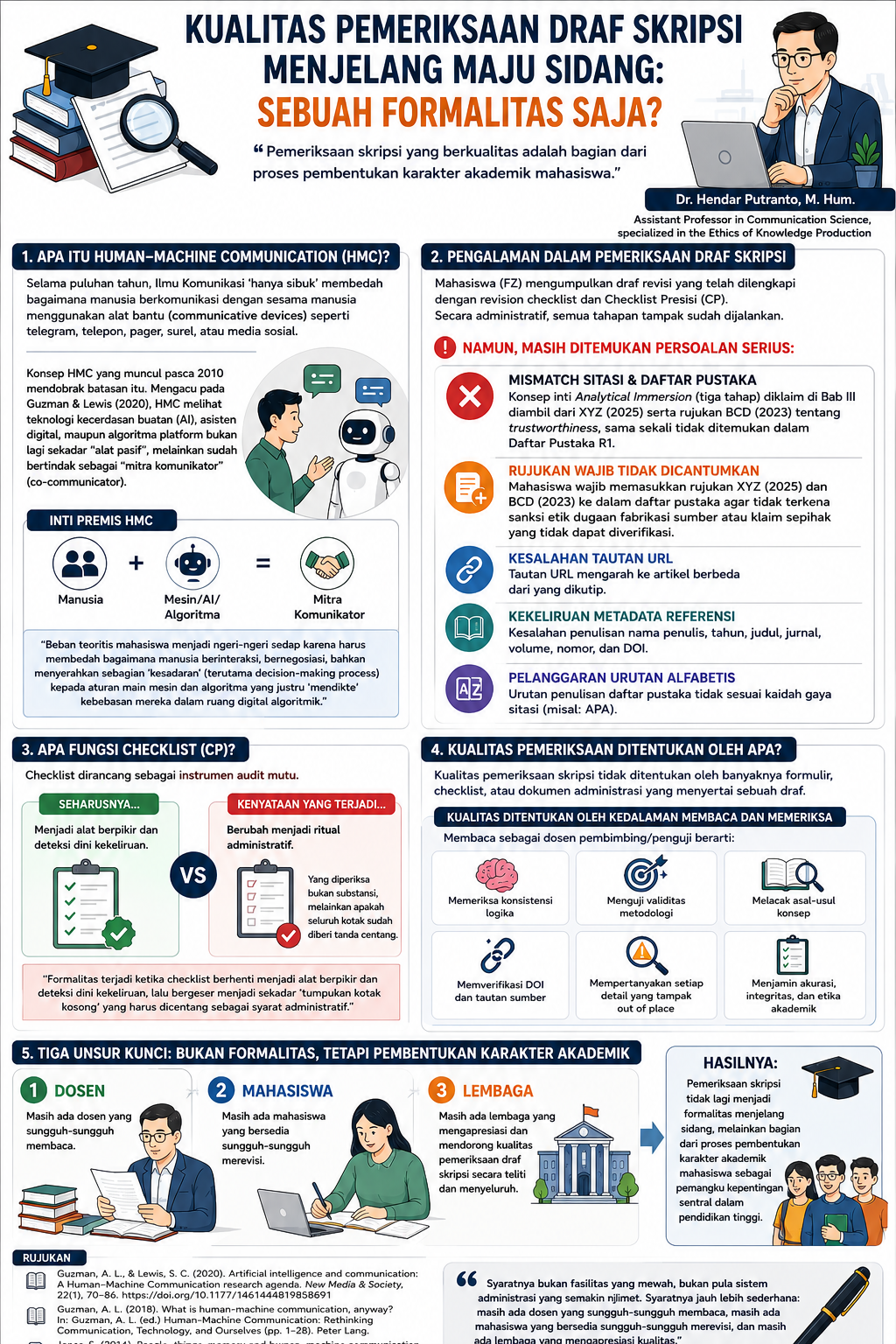
Bagi pembaca awam, mungkin ada yang bertanya-tanya: apa sebenarnya Human-Machine Communication (HMC) itu dan mengapa ia begitu rumit? Secara sederhana, premisnya dapat dirangkum sbb. Selama puluhan tahun Ilmu Komunikasi ‘hanya sibuk’ membedah bagaimana manusia berkomunikasi dengan sesama manusia menggunakan alat bantu (communicative devices) seperti telegram, telepon, pager, surel, atau media sosial. Konsep HMC yang muncul pasca 2010 mendobrak batasan itu.
Mengacu pada gagasan Guzman & Lewis (2020), HMC adalah sebuah peta jalan akademis baru yang melihat teknologi kecerdasan buatan (AI), asisten digital, maupun algoritma platform bukan lagi sekadar “alat pasif”, melainkan sudah bertindak sebagai “mitra komunikator” (co-communicator). Beban teoritis mahasiswa saya menjadi ngeri-ngeri sedap karena ia harus membedah bagaimana para live streamer ini berinteraksi, bernegosiasi, bahkan menyerahkan sebagian ‘kesadaran’ (khususnya decision-making process) mereka kepada aturan main mesin dan algoritma yang justru ‘mendikte’ kebebasan mereka dalam ruang digital algoritmik.
Kembali ke pengalaman mahasiswa yang saya bimbing.
Yang lebih menarik justru terjadi beberapa hari kemudian.
Mahasiswa tersebut mengumpulkan draf revisi yang telah dilengkapi dengan revision checklist dan Checklist Presisi (CP) yang sebelumnya saya susun untuk membantu proses swa-sunting. Secara administratif, semua tahapan tampak sudah dijalankan.
Namun ketika saya membaca bagian Daftar Pustaka secara cermat dan saksama, saya masih menemukan sejumlah persoalan yang seharusnya sudah tersaring sejak tahap pemeriksaan mandiri.
Dalam catatan revisi yang saya kirimkan, saya menulis:
“Terdapat mismatch yang cukup serius antara kutipan di dalam teks dengan Daftar Pustaka. Konsep inti Analytical Immersion tiga tahap yang diklaim di Bab III diambil dari XYZ (2025), serta rujukan BCD (2023) tentang trustworthiness, sama sekali tidak ditemukan dalam Daftar Pustaka R1.”
Pada bagian lain saya juga menulis:
“Mahasiswa wajib memasukkan rujukan XYZ (2025) dan BCD (2023) ke dalam daftar pustaka agar tidak terkena sanksi etik dugaan fabrikasi sumber atau klaim sepihak yang tidak dapat diverifikasi.”
Masalah tidak berhenti di situ. Saya juga menemukan kesalahan tautan URL yang mengarah ke artikel berbeda, kekeliruan metadata referensi, serta pelanggaran urutan alfabetis dalam daftar pustaka.
Pengalaman ini membuat saya kembali bertanya: apa sebenarnya fungsi checklist (CP) dalam proses penulisan skripsi?
Checklist pada dasarnya dirancang sebagai instrumen audit mutu. Namun dalam praktiknya, tidak jarang checklist berubah menjadi ritual administratif. Yang diperiksa bukan lagi substansi pekerjaannya, melainkan apakah seluruh kotak sudah diberi tanda centang.
Pada simpul ini, saya mulai melihat bahwa kualitas pemeriksaan skripsi tidak terutama ditentukan oleh banyaknya formulir, checklist, atau dokumen administrasi yang menyertai sebuah draf. Kualitas justru ditentukan oleh apakah masih ada orang (baca: mahasiswa S1) yang benar-benar membaca tulisannya sendiri dan memilikinya (owning it).
Membaca bukan sekadar melihat halaman demi halaman. Membaca sebagai seorang Dosen Pembimbing yang nantinya juga berperan sebagai penguji di ruang sidang, berarti memeriksa konsistensi logika, menguji validitas metodologi, melacak asal-usul konsep, memverifikasi DOI, dan mempertanyakan setiap detail yang tampak out of place atau terlalu bernuansa generic ala AI-assisted writing.
Formalitas bukan terjadi karena tidak ada checklist. Formalitas justru terjadi ketika checklist berhenti menjadi alat berpikir dan deteksi dini kekeliruan lalu bergeser menjadi sekadar ‘tumpukan kotak kosong’ yang harus dicentang sebagai syarat administratif.
Karena itu saya semakin yakin bahwa pemeriksaan skripsi yang berkualitas masih mungkin ditemukan, termasuk di perguruan tinggi swasta. Syaratnya bukan fasilitas yang mewah, bukan pula sistem administrasi yang semakin njlimet.
Syaratnya jauh lebih sederhana.
Masih ada dosen yang sungguh-sungguh membaca.
Masih ada mahasiswa yang bersedia sungguh-sungguh merevisi.
Masih ada lembaga yang mengapresiasi dan mendorong kualitas pemeriksaan draf skripsi secara teliti dan menyeluruh.
kritik atas kecenderungan audit culture dalam ranah pendidikan tinggi di Indonesia
Ketika ketiga unsur tersebut bertemu, pemeriksaan skripsi tidak lagi menjadi formalitas menjelang sidang, melainkan bagian dari proses pembentukan karakter akademik mahasiswa sebagai pemangku kepentingan sentral dalam pendidikan tinggi.
Rujukan
Guzman, A. L., & Lewis, S. C. (2020). Artificial intelligence and communication: A Human–Machine Communication research agenda. New Media & Society, 22(1), 70-86. https://doi.org/10.1177/1461444819858691
Guzman A. L. (2018) What is human-machine communication, anyway? In: Guzman, A. L. (ed.) Human-Machine Communication: Rethinking Communication, Technology, and Ourselves (pp. 1–28). Peter Lang.
Jones, S. (2014). People, things, memory and human-machine communication. International Journal of Media & Cultural Politics, 10(3), 245–258. https://doi.org/10.1386/macp.10.3.245_1